Verbal reasoning for modern hiring
Assess how candidates read a passage, separate what it says from what it merely suggests, and judge each conclusion on the evidence alone. Signals Verbal Reasoning uses a familiar reasoning format, with short, timed conclusions designed to make AI assistance harder.
 AI-resilient by design
 No specialist knowledge needed
Employers that trust Test Partnership





One passage, three conclusions, one at a time
Read first, then judge.
Candidates read a short passage, then judge three conclusions individually as True, False or Cannot say. The passage remains visible throughout, and every answer rests on the passage alone.
Inside a testlet
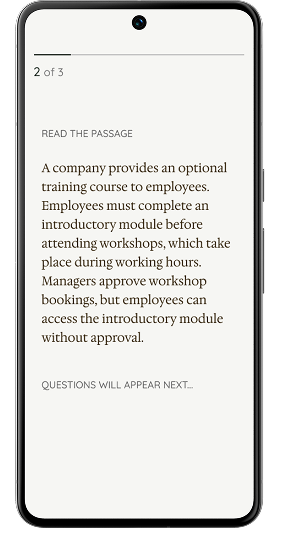
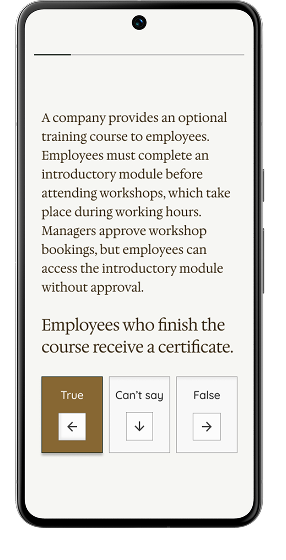
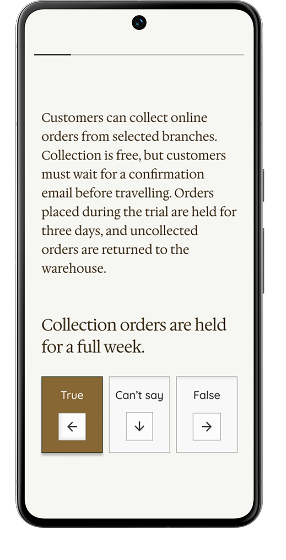
Three answers recorded. The next passage is chosen to match this candidate's estimated ability.
- Testlet A: below estimated ability
- Testlet B: selected for this candidate
- Testlet C: held for a later sitting
Drawn from a growing bank
Step 4 is illustrative. Candidates complete Signals on their own device, with instructions built in.
Read the six-page guide
What the assessment measures, what candidates see, how the format is designed to preserve the signal when candidates have AI to hand, and what your team gets back.
Written for talent teams, and easy to forward to whoever signs off your assessment process.
-
 Short sitting - A handful of testlets, timed per conclusion, leaving room for numerical or behavioural assessment.
 -
 Phone or desktop - Built mobile-first, with the passage kept in view and instructions built in.
 -
 Familiar format - Read the passage, judge the conclusion: True, False or Cannot say, as in established verbal tests.
 -
 Fair to any background - Everyday workplace passages, no specialist knowledge: graduates, apprentices and lateral hires alike.
The careful reading behind sound judgement
Passages reflect the written material professionals actually handle at work: briefings, policies, reports and correspondence. Every answer is based on the passage provided, with no prior sector knowledge required.
Signals Verbal Reasoning is typically used alongside Signals Numerical Reasoning, so candidates sit both in one short session and you get a combined ability profile against the same norm groups.
For graduate, apprentice and professional hiring in any role where reading accurately and reasoning from written information matters.
Read closely
Take in a short passage accurately and locate the detail that matters.
What does the passage actually say?
 Separate fact from assumption
Recognise when the passage does not say enough to decide, and resist filling the gap.
Is there enough here to know?
 Judge the conclusion
Decide whether each conclusion follows from the passage, against the clock.
True, False or Cannot say?

Familiar to candidates.
Harder to outsource.
When candidates outsource their reasoning to AI, scores become less useful for shortlisting. Signals builds AI resilience through assessment design rather than surveillance. No remote assessment is beyond AI assistance; Signals makes outsourcing an answer slower, harder and less reliable, and we monitor that as AI tools change: the format itself limits what outside help can achieve. The research behind this approach is set out in our whitepaper.
 One conclusion at a time
Candidates cannot capture all three conclusions together or preview what comes next.
Short answer windows
Individual timers limit the time available to capture a conclusion, obtain an external answer and enter it.
 Adaptive, randomised selection
Passages and conclusions are selected according to estimated ability and presented in randomised order, so candidates can encounter different content.

Signals uses Rasch calibration and computer adaptive testing to select passages suited to estimated ability. Item analysis informs the review of question quality and differences in performance across groups.
- Percentiles or STENs show performance relative to your selected comparison group
- View results in the platform and download PDF reports to support hiring discussions
-
 Export scores to CSV or Excel for your wider recruitment workflow
Discuss the assessment evidence, available norm groups and suitability for your campaign.
Talk to our psychologistsTrusted by hiring teams
These clients describe their experience of Test Partnership and our wider assessment service.
Since they upgraded these to gamified tests, it has only enhanced their effectiveness. Add to that their ability to identify candidates' true potential rather than that of ChatGPT, we consider it an invaluable part of our skills assessment process.
Alex Denise Head of Recruitment, GSR
Test Partnership has helped us bring more structure and objectivity into our hiring process. The assessments give us useful insight into candidate potential and help us identify stronger talent more efficiently.
Karima Khaled Fuad Zureiqi Senior Talent Acquisition Manager, Houlihan Lokey
These tests help us quickly narrow down large applicant pools and focus on candidates most likely to succeed. The platform is easy to use, and their team provides excellent support whenever needed.
Elma Jane Castillo Early Careers Lead, S&W

Signals Verbal Reasoning FAQs
Signals Verbal Reasoning is for any employer that screens on verbal ability, typically graduate, apprentice, intern and professional intakes. It suits any role where people read reports, policies or correspondence and need to act on exactly what was written, from professional services and law to the public sector and in-house teams. Candidates do not need a particular degree or specialist knowledge.
Use it at the stage where you assess verbal ability, before interviews or an assessment centre. Many teams pair it with Signals Numerical Reasoning in a single sitting. Our team can help you review how it fits your selection criteria and any other assessments you use.
A conclusion is True if the passage supports it, False if the passage contradicts it, and Cannot say if the passage does not give enough information to decide either way. Candidates answer from the passage alone, not from their own knowledge, which is why Cannot say is often the most discriminating of the three.
Yes. The assessment is designed for completion on the candidate’s own device, including a mobile. Passages are short, and the passage stays visible while each conclusion is answered.
Discuss candidate adjustments and assistive technology requirements with our team before your campaign, so the assessment can be configured appropriately.
Each passage is followed by three conclusions shown one at a time, each with its own short timer, with no previewing or going back, and the next testlet is selected adaptively from a growing bank, with passage and conclusion order randomised. These design features make it slower, harder and less reliable to outsource answers to an AI tool. Our fully game-based MindmetriQ suite adds a dynamic format where maximum resilience matters. Book a call to walk through the candidate experience, reporting and norm groups with one of our business psychologists.