Skip to Content
PROTECTING HIRING SIGNAL IN THE AGE OF AI

AI-resistant hiring

Protect candidate authenticity and shortlist quality with dynamic assessments designed to measure genuine ability, not AI-assisted applications.

01 · THE PROBLEM

How AI is affecting selection methods and hiring

The signals hiring teams used to rely on — tailored CVs, written answers, online test performance — have become easier to fake at scale with AI. For hiring teams the problem is not just cheating. It is signal loss: when candidate evidence becomes easier to optimise, it becomes harder to know who genuinely has the ability and potential to succeed.

1. How vulnerable is each selection method

CVs, cover letters and competency answers can be generated or polished by AI in seconds, so writing quality no longer signals candidate ability.

Find out what's vulnerable

2. How candidates can cheat

Fixed test or image items can be copied, pasted or screenshotted into an AI tool for an instant answer. The formats most exposed are static and untimed.

Candidate cheating tactics
02 · THE CONSEQUENCES

What signal loss means for employers

When candidate evidence can be optimised with AI, the damage is not abstract. It shows up directly in the quality and fairness of your hiring decisions.

Reduced confidence in shortlist quality

You can no longer be sure the strongest applications on paper reflect the strongest candidates in reality.

Weakened assessment validity

If scores partly reflect access to AI tools, the assessment measures less of the genuine ability that predicts job performance.

Unfairness to honest candidates

Candidates who complete assessments independently are disadvantaged against those using external assistance.

Progression on the wrong basis

Candidates can advance through your process on the strength of external assistance rather than genuine capability.

03 · THE SOLUTION

How Test Partnership protects the hiring signal

We protect the integrity of your results with a layered approach — prevent first, detect what slips through, and verify when you need extra confidence.

1. Prevent through design

Dynamic, interactive tasks, short timings, adaptive delivery and item banking make AI assistance impractical from the outset. This is the core of MindmetriQ™.

See design features

2. Detect suspicious behaviour

Built-in anti-cheat and AI-detection indicators flag patterns that suggest external assistance, so you can review results with the full picture.

See anti-cheat features

Retesting or supervised follow-up confirms a candidate's results when a role or a flagged result calls for additional confidence.

About verification testing
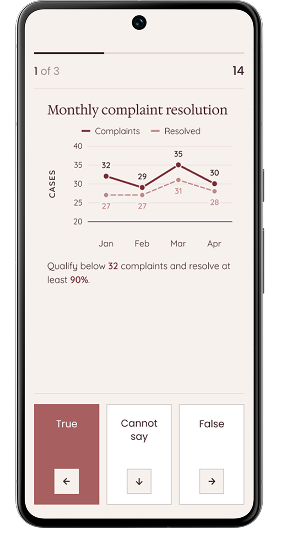
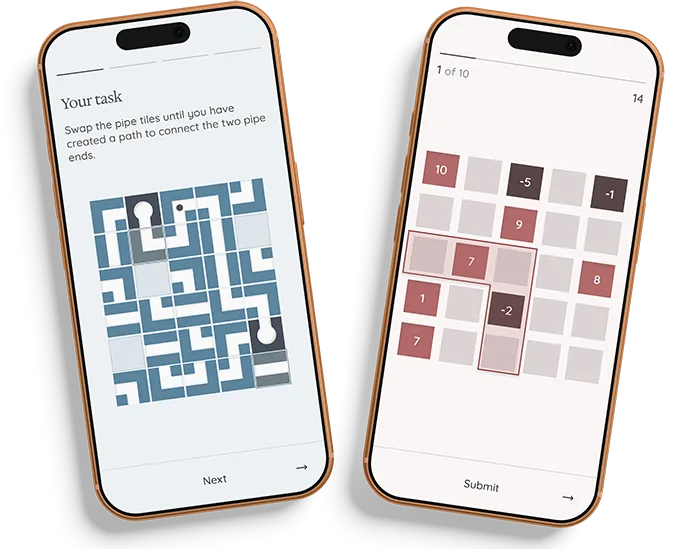
MindmetriQ dynamic game-based assessment interface

A more modern way to assess ability

These dynamic assessments are shorter, more engaging, and harder to cheat—without sacrificing predictive power.

  • Complete cognitive profile in 14 mins
  • Scientifically validated to predict job success
  • Shorter, interactive tests keep candidates focused
  • Fast-paced, dynamic format makes AI tools ineffective
Explore our MindmetriQ™ tests

Test Partnership's tests give one of our best indicators to future performance. The gamified tests have only enhanced their effectiveness, testing candidates on multiple levels simultaneously. Add to that their ability to identify candidates' true potential rather than that of ChatGPT, we consider it an invaluable part of our skills assessment process.

Free tools to pressure-test your process

Two quick, free tools that show you where your hiring process stands against AI today.

AI Cheating Calculator

Estimate how much undetected AI assistance could be inflating your shortlist — and what that means for your quality of hire.

Try the calculator
AI Resistance Scorecard

A free 2-minute scorecard that tells you, honestly, where your current process holds up against AI and where it doesn't.

Take the scorecard
EXPERT INSIGHT

Ben Schwencke, Chief Psychologist

Ben Schwencke, Chief Psychologist at Test Partnership

Ben leads Test Partnership's research and development, including the psychometric validation of MindmetriQ™. He holds an MSc in Organisational Psychology (Birkbeck, University of London), is a BPS Registered Test User in ability and personality testing, and has spent more than 10 years designing psychometric assessments, specialising in computer-adaptive testing and item response theory. In these two short explainers, he breaks down how generative AI is eroding traditional hiring signals — and which parts of the process are most exposed in 2026.

Full bio · LinkedIn

How AI is destroying hiring signal

Ben Schwencke explains how AI is destroying hiring signal. What should employers trust now?

Key takeaway: generative AI makes polish free — well-written applications and correct answers on static tests no longer signal genuine candidate ability.

The part of hiring most vulnerable to AI (2026)

Which part of the hiring process is now most vulnerable to AI cheating? Ben Schwencke explains.

Key takeaway: static, text-based stages are the most exposed — dynamic, game-based measurement is far harder to outsource to an AI.

AI-resistant hiring FAQs

Yes, especially where assessments use static text, images or answer options that can be copied, pasted or screenshotted into AI tools. The risk is highest when the test exposes the full question and gives candidates enough time to solve it externally.

No. Proctoring tries to detect or deter cheating. AI-resistant assessment design aims to make AI assistance impractical in the first place.

No assessment should claim to be completely cheat-proof. The realistic goal is to reduce the usefulness of AI assistance so results more closely reflect genuine candidate ability.

They should. AI resistance is only useful if the assessment remains valid, reliable and job-relevant. The security layer should support psychometric quality, not replace it.