Skip to Content

Ability tests, rebuilt for the AI era.

Candidates now have AI to hand when they sit a remote test. Signals keeps the numerical, verbal and critical thinking formats employers and candidates know, and changes how the questions are delivered, so the score you see is the candidate's own reasoning.

  • clock icon 8–14 mins per test
  • document icon One combined report
  • shield, icon AI-resilient by design
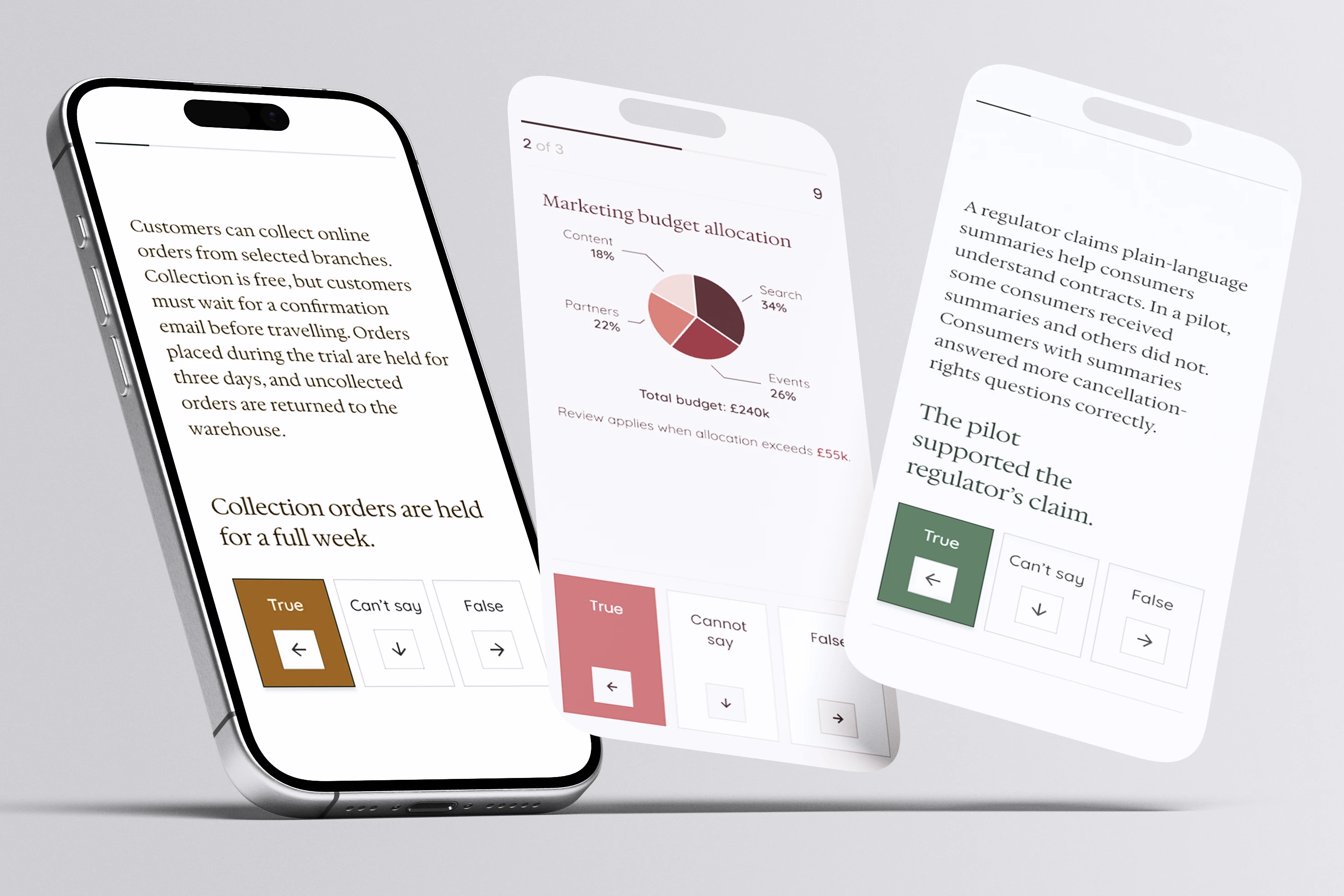
The three Signals tests shown on mobile: a numerical chart, a short verbal passage and a critical thinking argument, each with a question and a timer

Employers that trust Test Partnership

MUFG logo
Houlihan Lokey logo
Eversheds Sutherland logo
XTX Markets logo
Taylor Wessing logo
GSR logo
DAC Beachcroft logo
Ironshield logo
MUFG logo
Houlihan Lokey logo
Eversheds Sutherland logo
XTX Markets logo
Taylor Wessing logo
GSR logo
DAC Beachcroft logo
Ironshield logo

Keep the reasoning. Rethink the test experience.

The Signals Series is three ability tests: Numerical Reasoning and Verbal Reasoning for any role, and Critical Thinking, built for legal recruitment. Each one shows candidates the source material first, a chart, a table or a short passage, then presents timed questions one at a time, drawn adaptively from a question bank.

Use the tests that match the role rather than all three by default. Whichever you choose, candidates sit them in one session on their own device and you get one combined report.

WHAT CANDIDATES EXPERIENCE
  • clock, icon Short - 8 to 14 minutes per test, so all three fit in one sitting.
  • monitor, icon Any device - Designed for mobile as well as desktop, with instructions built in.
  • pie chart, icon Familiar - Standard question types, so candidates focus on the questions rather than learning a new format.
  • user tick, icon Reasoning, not knowledge - Everyday workplace content, whether the candidate is a graduate, an apprentice or an experienced hire.

Test Partnership has helped us bring more structure and objectivity into our hiring process. The assessments give us useful insight into candidate potential and help us identify stronger talent more efficiently.

Why choose Signals?

Most online ability tests were designed before candidates had AI tools to hand. Signals keeps the format you know and changes how the questions are delivered: source material first, then one timed question at a time. No remote assessment is completely immune to AI assistance; Signals is designed to make it slow, awkward and unreliable, and we keep testing that as AI tools change.

Static online tests

  • cross, icon Several questions on screen at once, easily copied into an AI tool.
  • cross, icon One long time limit for the whole test, with plenty of slack to look answers up.
  • cross, icon Candidates can go back and change answers.
  • cross, icon The same fixed set of questions for every candidate.
  • cross, icon Long sittings, with drop-off to match.

Signals

  • check, icon One question on screen at a time.
  • check, icon A short time limit on every question, not just the test.
  • check, icon No going back once a question is answered.
  • check, icon Questions drawn adaptively from a bank, so candidates see different content.
  • check, icon 8 to 14 minutes per test, with one report across the series.

The Signals Series

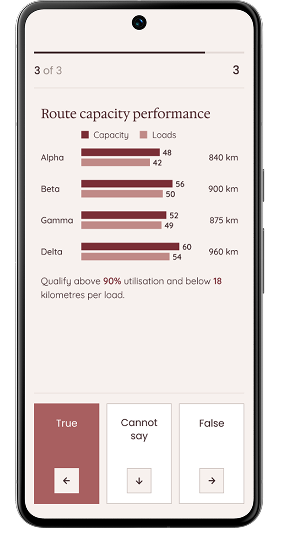
Signals Numerical Reasoning on mobile: a chart with a question and its countdown timer

Numerical Reasoning

  • icon, clock 14 mins
  • icon, document 36 questions

Three subtests, Fluency, Interpretation and Analysis, take candidates from quick judgements about charts and tables to more involved analysis of business data.

Abilities assessed: numerical reasoning, data interpretation, accuracy with figures.
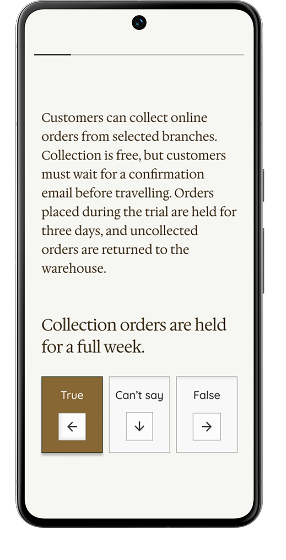
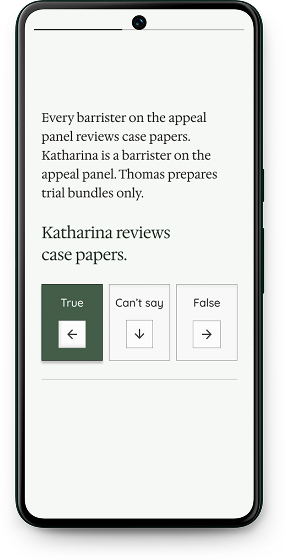
Signals Verbal Reasoning on mobile: a short passage with a conclusion to judge and its countdown timer

Verbal Reasoning

  • icon, clock 8 mins
  • icon, document 24 questions

Eight short workplace passages, each followed by three conclusions to judge True, False or Cannot Say.

Abilities assessed: verbal reasoning, comprehension, separating evidence from assumption.

Signals Critical Thinking on mobile: a short passage with a question and its countdown timer

Critical Thinking

  • icon, clock 10 mins
  • icon, document 48 questions

Built for legal recruitment. Three subtests, Conclusions, Deductive and Arguments, test how candidates reason with evidence, linked statements and competing arguments.

Abilities assessed: critical thinking, deductive reasoning, evaluating arguments.

How to use them in your recruitment

We're often asked: "Do we use all three?" The answer depends on the role.

Numerical and Verbal together are the standard ability screen for most roles. Critical Thinking was built for legal early careers recruitment and suits any role that turns on weighing arguments and evidence. Any test can be used on its own. Whichever you choose, candidates sit them in one session and you get one report.

user tick, icon Early careers at volume

Numerical and Verbal to sift large graduate, apprentice and intern pools quickly and fairly.

Early careers hiring

pie chart, icon Finance

Numerical, with Verbal alongside, for analyst and advisory intakes.

Finance hiring

target, icon Legal

Critical Thinking for training contract and vacation scheme campaigns, with Verbal if required.

Legal hiring

tick, icon Professional services

Numerical and Verbal for consulting, accountancy and advisory roles, with Critical Thinking where the work turns on arguments and evidence.

Talk to us
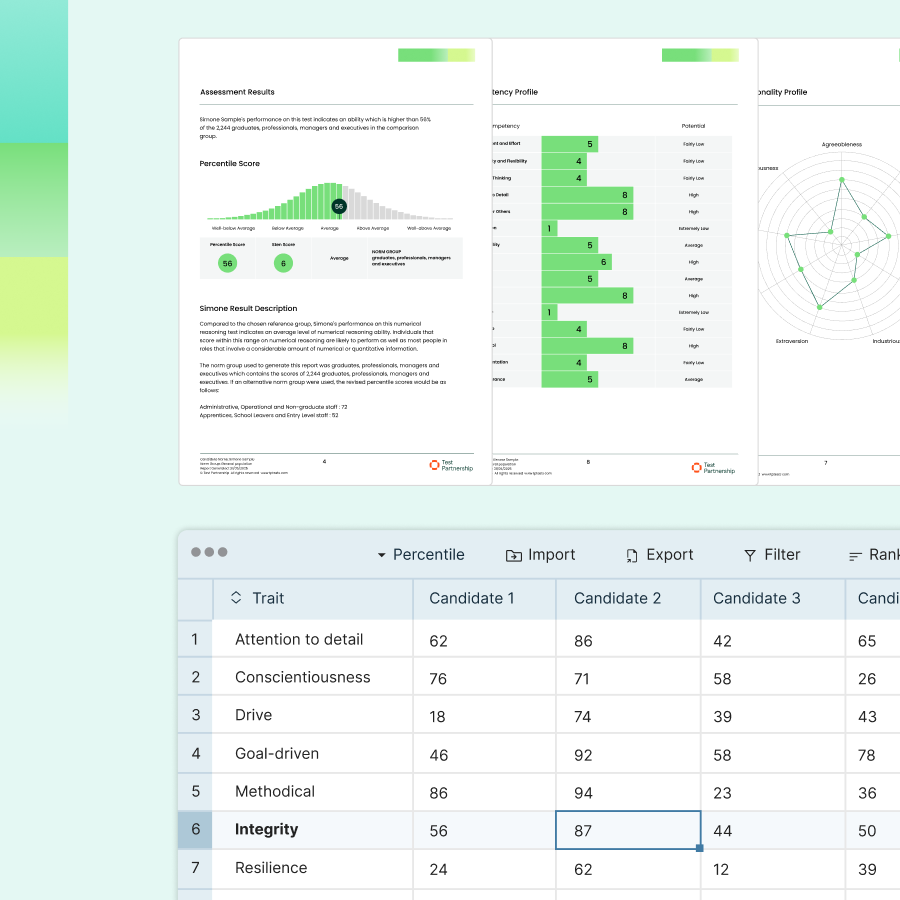
Signals combined report showing a percentile for each of the three tests

Clear results. Informed decisions.

Each candidate gets one report covering every test they sat, with a percentile or STEN score for each against your chosen comparison group. View and compare results in the platform, download PDF reports, or export scores to CSV or Excel.

Signals tests are built and maintained by our business psychologists. Questions are calibrated using Rasch measurement and delivered adaptively, and every item is monitored for quality and for differences in performance between groups. Ask us for the technical documentation.

Talk to our psychologists

Guides and research

How the tests are designed, what candidates see, and the research behind our approach to AI resilience.

Signals Series FAQs

No. Use any one test on its own or any combination. Numerical and Verbal Reasoning are the standard pairing for most roles; Critical Thinking was built for legal recruitment and suits other roles that turn on arguments and evidence.

Numerical Reasoning takes about 14 minutes, Critical Thinking about 10 and Verbal Reasoning about 8, so all three fit in roughly half an hour in one sitting, leaving room for a behavioural assessment or interview in the same stage.

Yes. Questions are selected from a bank to match the candidate's estimated ability as the test progresses, so two candidates sitting the same test will see different questions. Scores stay directly comparable because every question is calibrated on the same scale.

Candidates see the source material first, then answer one timed question at a time with no going back, and questions are drawn adaptively from a bank. Together these make an AI tool slow and unreliable to use mid-test. No remote assessment is completely immune, and we keep testing Signals as AI tools change. The research is set out in our AI-resilience whitepaper.

Both are built by the same psychologists to the same standards. MindmetriQ measures general cognitive ability through short game-based tasks, and its dynamic format gives it our highest level of AI resilience. Signals measures specific reasoning abilities in a conventional test format. Choose on what you need to measure and the candidate experience you want; many clients use both.

Yes. Signals is designed to be taken on the candidate's own device, including a phone. The passage, table or chart stays on screen while each question is answered.

Discuss candidate adjustments and assistive technology requirements with our team before your campaign, so the assessments can be configured appropriately.