Critical thinking for legal hiring
Assess how candidates analyse information, evaluate arguments and draw conclusions in legal contexts. Signals Critical Thinking uses a familiar reasoning format, with short, timed questions designed to make AI assistance harder.
 AI-resilient by design
 No legal knowledge needed
Law firms that trust Test Partnership





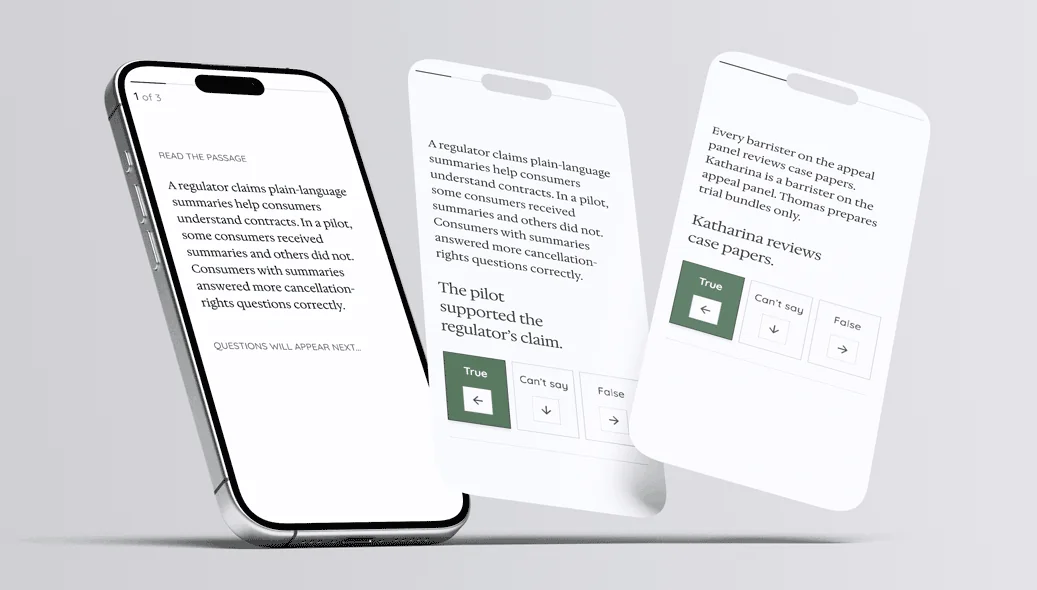
One passage, four questions, one at a time
Read first, then answer.
Candidates review a short passage, then answer four questions individually. The passage remains visible throughout.
Inside a testlet
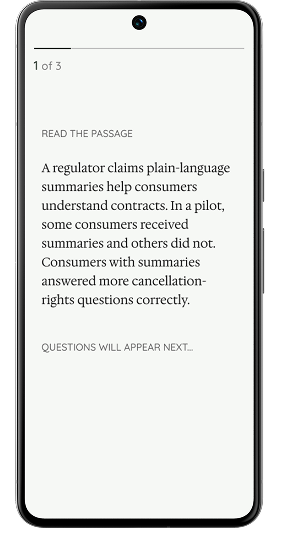
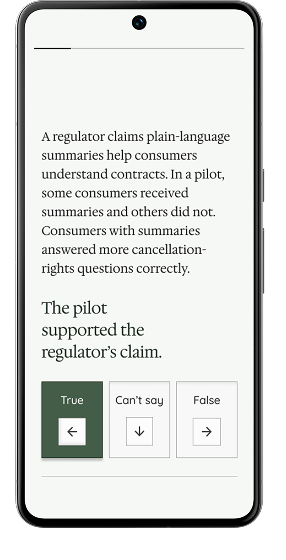
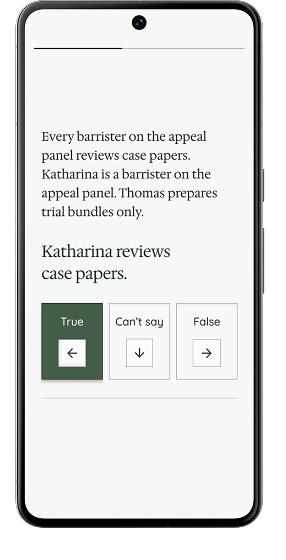
Four answers recorded. The next stem is chosen to match this candidate's estimated ability.
- Testlet A: below estimated ability
- Testlet B: selected for this candidate
- Testlet C: held for a later sitting
Drawn from a growing bank
Step 4 is illustrative. Candidates complete Signals on their own device, with instructions built in.
Sit a practice testlet
The quickest way to judge the format is to sit it. You'll see a stem appear on its own, then four questions one at a time, each on its own clock — exactly as a candidate would.
It's a practice run, not a full assessment, and you'll get a raw score at the end. The point is to feel the pace from the candidate's side.
-
 Under five minutes - A handful of testlets, timed per question.
 -
 Phone or desktop - Built mobile-first, so your phone is fine.
 -
 Raw score at the end - Unnormed, so treat it as a taste rather than a result.
 -
 Opens in a new tab - This page stays where you left it.
Reasoning grounded in legal work
Use realistic legal scenarios to explore how candidates think. Every answer is based on the information provided, with no prior legal knowledge required.
For legal recruitment, including training contract and vacation scheme campaigns.
 Analyse information
Separate what the evidence establishes from what is assumed or left uncertain.
What does the evidence actually show?
 Evaluate arguments
Assess whether an argument is supported by the information and relevant to the issue.
Does the argument hold up?
 Draw conclusions
Judge whether a conclusion follows from the information provided.
Is that conclusion justified?

Familiar to candidates.
Harder to outsource.
When candidates outsource their reasoning to AI, scores become less useful for shortlisting. Signals builds AI resilience through assessment design rather than surveillance: the format itself limits what outside help can achieve. The research behind this approach is set out in our whitepaper.
 One question at a time
Candidates cannot capture all four questions together or preview what comes next.
Short answer windows
Individual timers limit the time available to capture a question, obtain an external answer and enter it.
 Adaptive selection
Question sets are selected according to estimated ability, so candidates can encounter different content.

Signals uses Rasch calibration and computer adaptive testing to select questions suited to estimated ability. Item analysis informs the review of question quality and differences in performance across groups.
- Percentiles or STENs show performance relative to your selected comparison group
- View results in the platform and download PDF reports to support hiring discussions
- Export scores to CSV or Excel for your wider recruitment workflow
Discuss the assessment evidence, available norm groups and suitability for your campaign.
Talk to our psychologistsTrusted by legal hiring teams
These clients describe their experience of Test Partnership and our wider assessment service.
Test Partnership has helped us create a more consistent and objective hiring process. The assessments support fairer decision-making and have been a valuable part of our broader approach to inclusive recruitment.
Catherine Knight Senior Talent Manager, Eversheds Sutherland
Test Partnership has helped us bring great insight and objectivity to our early talent application process across training contracts, apprenticeships, and internships. We also value their supportive approach and clear communication, which contribute to a smooth and positive candidate experience.
Mwansa Chomba Early Talent Assistant, DAC Beachcroft LLP
The candidate preparation hub has been a really valuable part of the process. It helps candidates feel better informed and better prepared, which creates a more positive overall experience.
Nicola Micklewright Early Talent Senior Manager, Taylor Wessing
Signals Critical Thinking FAQs
Signals is designed for legal hiring, particularly early careers campaigns such as training contracts and vacation schemes. Candidates do not need a law degree or prior legal knowledge.
Use it at the stage where you assess critical thinking, before interviews or an assessment centre. Our team can help you review how it fits your selection criteria and any other assessments you use.
Yes. The assessment is designed for completion on the candidate’s own device, including a mobile. The passage stays visible while each question is answered.
Discuss candidate adjustments and assistive technology requirements with our team before your campaign, so the assessment can be configured appropriately.
Book a call to walk through the candidate experience, reporting and available norm groups with one of our business psychologists.