Verification tests can help prevent AI cheating
 3 minutes
Find out how using verification tests can help prevent AI-cheating in your hiring process.


Forget the pursuit of happiness, everyone in TA is on the pursuit of how to stop candidates cheating in online assessments (Oscar-winning film, right there).
I will admit it's hard to eliminate AI cheating entirely, particularly as candidates are completing assessments remotely. But there are ways to make AI use detectable, difficult and, ideally, not worth the effort.
There's a difference between detecting AI-use, and preventing AI-use. We'll cover both and suggest what the best cheat-resistant assessment looks like.
There isn't a single reliable "AI-detector" for online assessments. Instead test providers will use a combination of measures to detect behaviour that looks suspicious.
None should be used as proof on their own, but together can help build a picture of if a candidate is likely to be cheating.
Behaviour tracking helps detect if a candidate leaves the test window, helping to track whether additional tabs or browsers are being used during the assessment.
These "mouse-outs" are most useful when reviewed as patterns rather than isolated events. Consistently exiting the screen for most questions is a strong indicator of cheating, however, a couple of standalone instances does not strongly suggest any cheating.
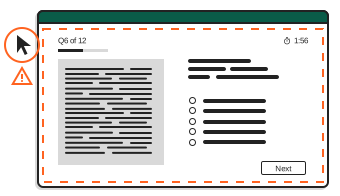
Commonly called "proctoring", this involves continuous or periodic capture of the desktop and the user's webcam in order to capture possible cheating. This is probably the most effective detection method, but proctoring comes at a cost to the user experience.
As you can imagine this raises significant privacy concerns, can increase candidate drop-off, create accessibility issues, and harm employer brand.
It's effective, but I'd think carefully before making it the default for every candidate. Especially as it's still technically bypassable, depending on the setup, by using a phone out of view, or speaking to the AI instead of typing.
Verification tests are a shorter follow-up assessment used later in the process, typically for your finalists, to see if candidates can reproduce similar scores. If a candidate's verification score is noticeably lower then it's likely they received some assistance in the first assessment.
Even the threat of verification assessments being used can be enough to dissuade candidates from considering cheating.
3 minutesFind out how using verification tests can help prevent AI-cheating in your hiring process.
That said, there are two limitations worth noting. First, verification assessments don't protect the fairness of your initial screening stage - if a large proportion of candidates used AI to reach your finalist pool, the damage is already done. Second, there's an admin cost to running follow-up assessments for every finalist, which adds time to an already busy stage of the process.
Preventing people using AI is much more useful than simply detecting if someone used ChatGPT in your test.
A simple clear warning, before the assessment begins, is surprisingly effective at reducing AI use.
Candidates are asked to confirm they won't use external help and are informed that behaviour may be monitored or verified later. Many candidates won't risk using AI if they believe there's a realistic chance of being caught and rejected because of it.
This takes the browser switching one step further by disabling that ability entirely.
If a test publisher ran their assessment via an app, which the candidate has to download onto their device, then the app would then be able to control and monitor what other programmes are running. The app can force the test to be fullscreen and not exitable until the candidate has completed and submitted the test.
You might be thinking that sounds pretty perfect, but remember what I mentioned as the workaround for browser monitoring: a second device.
Locking down someone's laptop is pretend security when the candidate can simply get out their phone to run their AI tool.
That's the fundamental problem with remote testing. You can control the assessment environment on one device, but not necessarily everything around it.
What these anti-cheat measures are trying to solve is a weakness in the design of traditional aptitude tests. The questions are static, so everything an AI tool needs is often contained in one screenshot. That makes copying the question and getting an answer very easy.
AI-resistant assessments are designed in a way to prevent AI-assistance being helpful. They're interactive, have much shorter time-limits, and the tasks require answers that AI cannot easily provide. We cover in more detail what makes an assessment AI-resistant, if you would like to learn more.
However, the assessment still needs to measure the ability you actually care about. Historically, many gamified assessments have focused on personality rather than cognitive ability. Test Partnership's MindmetriQ assessments measure numerical, verbal and logical reasoning using formats specifically designed to be difficult for AI to complete.
There isn't a single anti-AI feature that will stop every determined candidate from trying to cheat. Most monitoring-based approaches catch AI cheating after the fact, when in reality we just want to prevent candidates from being able to use AI in the first place.
That's why we designed our AI-resistant MindmetriQ assessments. So you can continue testing numerical, verbal, and logical reasoning, without your results being distorted by AI-assisted candidates.

Chief psychologist at Test Partnership. MSc in Organisational Psychology with over 10 years' experience in psychometric testing.
