

If you're searching for how to hire better managers, you probably already know something's gone wrong, or at least suspect it might. So let's skip the part where I explain why bad managers are a problem and get straight into how to spot a good one before you've hired them.
The issue isn't that great managers are particularly rare. It's that you need to be looking for a very particular set of skills (Liam Neeson voice), that separate the David Brents from the competent managers you're actually looking for.
The most common pitfalls are fixable and often come down to using weak selection tools
According to Gallup, companies pick the wrong person for management roles 82% of the time. And it makes sense when you understand that a lot of common practices aren't too reliable.
CVs are weak predictors of performance, even when looking at experience and job history
Over a hundred years of research has shown that CVs have a correlation with job performance of around 0.1 (on a scale of 0 to 1), which if you can't tell is very low. The researchers Schmidt, Oh, and Schaffer (2016) labelled them as "unlikely to be useful" for predicting performance. If those stats have piqued your interest, we have an article that breaks down the science of selection methods which is worth a read.
You should obviously still look at your potential managers' CVs, or at least the relevant information from application forms.
But CVs shouldn't be the main thing you're using to judge someone's ability. Mainly because they don't tell you how good someone is at problem solving, learning quickly, working with others, or doing the actual job - which are all the key traits you want to be measuring to improve the quality of your managerial hires.
With managerial hires, a CV can make someone look strong because they've held similar roles, but similar experience does not automatically mean high ability or strong performance. It just means they held that role for a while. It can also exclude people who have the right potential but a less conventional background or no current managerial experience.
Don't overvalue interviews, especially unstructured ones
You know the ones, where the conversation flows naturally and the questions vary depending on how things go. They tend to reward how well someone presents themselves and how likeable they come across, rather than the qualities that'll actually make them effective as managers. They feel useful in the moment, but they're not a reliable way to predict how someone will actually perform.
Often interview performance can overshadow everything else, and you end up hiring someone just because you got on with them and they came across as good "manager material". Interviews are important - I'll cover how structured interviews are useful for assessing certain soft skills later on.
Promoting your best individual contributors into management can often be a mistake
Technical excellence and managerial capacity are genuinely different things. Someone brilliant at their job isn't automatically good at developing other people, resolving conflict, or holding a team accountable through a difficult period.
High performers tend to like doing the work themselves, that's frequently why they're high performers. So when they move into management, delegation might feel inefficient and coaching a distraction from getting things done. The people-orientation and instinct to develop others that effective managers need is a genuinely different quality, and it's often absent in exactly the people most likely to get promoted.
Internal promotion can work, but only with the right candidate, not just the highest performer.
The traits that actually predict managerial effectiveness are specific and measurable
Luckily for you, the traits which distinguish effective managers from ineffective ones are well understood, and they can be measured. They fall into three buckets.
Cognitive traits
Managers need strong cognitive ability.
Cognitive ability is the strongest single predictor for management roles. Remember that study of over 100 years of research I mentioned earlier? Where CVs had a validity of 0.1? Well, mental ability scored at the top of the list with 0.65 for predicting job performance.
This included high-complexity jobs and management roles. And it found as the complexity of the role increases, so too does the predictiveness of mental ability. That's because managing people is cognitively demanding in a specific way: abstract reasoning about competing priorities, anticipating the knock-on effects of a decision, processing ambiguous information without much time to deliberate.
So cognitive ability is over 50% of what you should be looking for in your next managers (if you want them to be good, which we obviously do). The rest are soft skills which come in the following two forms.
Intrapersonal traits
These are the internal behaviours and habits that determine how you face challenges and manage your thoughts and emotions. Key traits for managers are:
- Decisiveness - setting goals, feeling in control, thinking through consequences, drive to succeed and push through obstacles.
- Resilience - staying calm under pressure, maintaining positivity, handling setbacks without falling apart.
- Planning and delivering - upholding procedure, remaining productive and focused, seeing projects through to completion, showing initiative.
Interpersonal traits
These are the people-facing skills; skills employed when we interact with one another. Research by Beenen et al. (2021) looked into what the key skills of managers. They interviewed practicing managers and found through multiple validation studies that the interpersonal skills critical to managerial effectiveness fall into three categories:
- Supporting - providing guidance and backing to team members, creating an environment of safety.
- Motivating - inspiring others towards goals, maintaining energy and drive across the team.
- Managing conflict - addressing under-performance, navigating disagreements, holding difficult conversations.
Google found that interpersonal skills such as coaching others and communicating were more important to employee performance than hard skills.
But soft skills alone will not create a high-performing manager, neither will just high cognitive ability.
Hiring the best managers comes down to finding those who possess both high cognitive ability + the right soft skills.
None of this is visible on a CV. And only the interpersonal traits come through in an interview. So you need something else to measure the other two groups.
Cognitive and behavioural assessments help give you the best picture of managerial potential
So how do you actually measure these traits in your managerial candidates?
We've helped hundreds of companies with their hiring needs, including many who were hiring for leadership positions. The approach that worked best for them comes down to using three different assessment methods, each measuring the three different buckets we covered above.
Ability tests are perfect for assessing cognitive ability
Measuring each candidate's cognitive ability is pretty simple.
I would recommend a critical thinking test, as this measures a candidate's ability to evaluate arguments, weigh up evidence, and reach sound conclusions under pressure - exactly what managers are doing when making decisions.
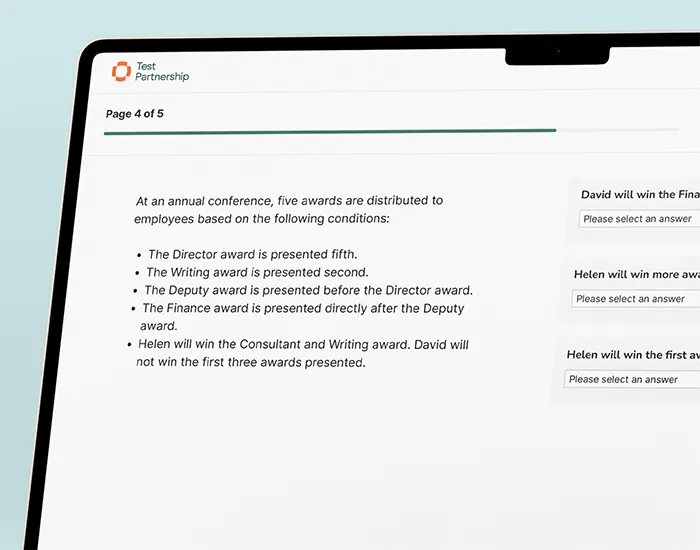
Depending on the role you might pair it with a numerical reasoning test if the position involves a lot of data work, or an inductive reasoning test if it's more systems-focused or needs outside-the-box thinking.
I wouldn't use all three as the time it takes to complete does add up, each test is around 15 minutes and we still need to assess their soft skills! I would even say only add the second assessment if you feel it is critical to the role and you want a very thorough assessment. Adding a second will cause some attrition, and a critical thinking test is usually a good enough measure on its own.
Use personality assessments for the intrapersonal traits
Personality questionnaires are better at capturing the intrapersonal traits I covered earlier.
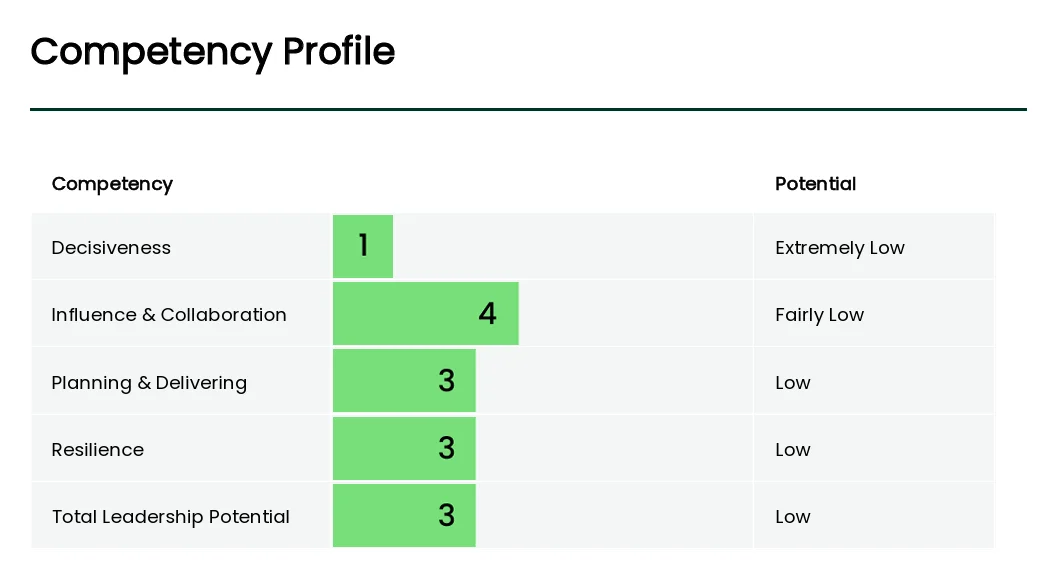
We designed a Leadership Profile assessment specifically to measure the traits research consistently link to effective leadership:
- Decisiveness is measured via goal focus, confidence, drive, and self-direction.
- Planning and delivering is scored on diligence, discipline, persistence, and initiative.
- Resilience is broken down into calmness, positivity, composure, and self-esteem.
- Influence and collaboration is underpinned by traits of outgoing, sociable, assertive, and trusting.
Using this assessment will give you scores for each of those measures, as well as an aggregated overall "leadership potential" score.
Administering these tests is super easy
What I love about online assessments is how scalable they are compared to every other selection method.
You can set both the critical thinking test and the leadership assessment as the first step in your candidate assessment process (to be completed when someone applies for the role). By the time you sit down to look at who's applied, you don't have 50 or 300 CVs to work through manually. You have all your applicants ranked by their scores on both these assessments.
It's basically all your applicants ranked on their managerial potential.
You can then choose the top however many to interview, and use the interview to assess them on their interpersonal skills (knowing they already have the cognitive and intrapersonal traits needed to be a great manager).
Assessing interpersonal skills in your structured interviews
I won't go too in-depth here, you already know how to interview people, I'm not trying to tell you how to do your job.
But my main bit of advice is you'll want to have interview questions that map to the three key categories I mentioned earlier: supporting, motivating, and conflict resolution. But a few example questions could be:
| Trait being assessed | Example question |
|---|---|
| Supporting | Tell me about a time when someone on your team was struggling. How did you support them? |
| Motivating | Describe a situation where you had to get someone excited about a project they weren't initially interested in. How did you approach it? |
| Managing conflict | Describe a situation where you had to address underperformance in someone on your team. Walk me through how you handled it. |
| Managing conflict | Give me an example of when you had to hold someone accountable for something they weren't delivering on. What did you do? |
For candidates coming from individual contributor backgrounds without managerial experience, the same questions still work - just tell them they can draw examples from wider context. You want to listen for whether they've made the mental shift from doing to developing.
 Pro Tip
Try to have a scoring rubric that sets out what strong, average, and weak answers look like before you've interviewed your first candidate, so you're not calibrating scores based on whatever previous candidates have said so far.
Don't allow gut feel to override your new objective data
It's important not to scrap the previous scores and pick whoever came across as the most engaging in the interview, as this will be a step back to the old ways and you'll soon be searching 'how to hire better managers' again.
Research from the National Bureau of Economic Research tested exactly this, where they found when hiring managers were given test scores but allowed to override them, the hiring outcomes got worse. The overrides weren't adding value, they were leading to worse decisions.
Conclusion and next steps
A lot of organisations are using methods that reward confidence, credentials, and likeability, but these won't reliably identify the people who'll actually develop a team, navigate conflict well, and sustain performance over time.
What actually works is reasonably well established: cognitive ability assessments, calibrated personality measures, and structured interviews with scoring criteria. These three assessment methods are like the holy trinity for leadership hiring.
None of this requires a drastic overhaul of how you hire. Adding a test provider can be very simple, hundreds of hiring teams have used us to this effect and it's incredibly simple and straightforward.
Check out our critical thinking test, our leadership profile assessment, or our leadership page where you can find some sample reports and testimonials from our clients.

Joshua Hancock
Digital Marketing Manager at Test Partnership. Over seven years' experience as a writer, content strategist, SEO and digital marketer.

