
Free Skills-Based Hiring Toolkit
Download to follow along this excercise of implementing your own skills-based hiring.
Claim your toolkit (PDF, 20MB)

If you've read our piece on what skills-based hiring actually is, then you already understand what it's all about. This is how you build a skills-based process from the ground up, without overcomplicating it or screaming into the office fridge in a rage of frustration.
We've put together a free toolkit that walks you through each stage, and I'll refer to it at times. There's a download link at the bottom if you'd rather grab it first and follow along.
This is the most important step, and you won't want to rush or skip this one. It's kind of the whole premise of skills-based hiring - you can't hire for skills if you don't know what skills you need.
Most people have a rough sense of what they want, "someone sharp, good with people, picks things up quickly", but we want something more concrete and framework-y than that.
You need to get specific. What does a high performer in this role actually look like at six months? What separates them from someone who's just getting by? And which of those qualities can you actually measure?
Skills tend to fall into three buckets:
The toolkit walks you through a structured brainstorm for each skill type, with worked examples and full appendices to draw from if you're not sure where to start. Aim for around 6-12 soft skills, the cognitive skills most relevant to the role, and only the hard skills that are genuinely non-negotiable.
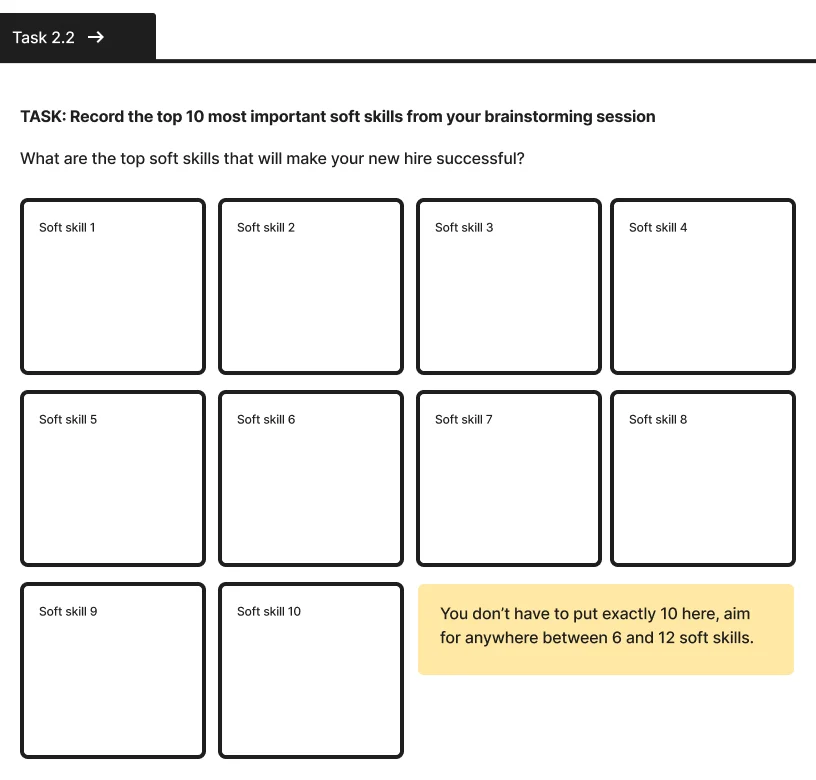
One thing worth doing at this stage: don't do it alone. Bring in line managers, existing high performers in the role, anyone with a real view of what good actually looks like in practice. The more grounded your skills framework is in how the role works day-to-day, the more useful it'll be when you're assessing candidates against it.
Say you're hiring a Customer Success Manager. You've done your brainstorm, spoken to your best existing CSMs, and thought about what actually separates the ones who thrive from the ones who struggle. Here's what you might land on:
That's it. Not a laundry list of requirements that rules out half the people who'd be brilliant in the role. A focused, honest picture of what good actually looks like.
And if you hired someone who possessed all those skills you'd be pretty happy with that hire. Probably more so than if you were mainly basing it on a degree and 2 years similar experience.
Now you're hiring for skills, you want to be open and inviting to candidates.
Out goes the old requirements section that was putting off strong candidates over boxes they didn't tick. In comes your new list of skills, the key ones at least, not the full set.
You don't need to list every skill you're planning to assess, or organise them into buckets on the job spec. That's your internal hiring framework, not a document for candidates. The job description just needs to signal the kind of person you're looking for, in plain language that attracts the right applicants rather than filtering them out on arbitrary criteria.
For example, here are some common experience-based requirements and how they could be rewritten into more skills-based, candidate-friendly language:
| Old requirements (experience-based) | New requirements (skills-based) |
|---|---|
| Minimum 2:1 degree in a related field | Comfortable interpreting information, working with data, and using evidence to make sound decisions |
| 3+ years’ experience in a similar role | Able to apply relevant skills quickly, learn new processes, and work autonomously |
| Demonstrable track record managing stakeholder relationships | Able to build trust, communicate clearly with different people, and manage expectations professionally |
| Previous experience with project management tools | Able to organise work, manage deadlines, and keep multiple tasks or projects moving at the same time |
| Experience presenting to senior leaders | Able to explain ideas clearly and confidently, adapting the message to suit the audience |
 Pro Tip
We no longer need a salary range that says "dependent on experience". What this really meant was more experienced = more skilled = higher pay. But as we're not prioritising experience, there's no need to base their pay on years in the field. Instead offer a salary that reflects how strong their skill ratings are, as that is a better measure of their future performance.
This is the heart of it, and the bit that tends to feel most unfamiliar if you haven't used many structured assessments before. Dropping CVs as your primary screening tool goes against years of habit. But there's almost nothing in a CV that reliably predicts job performance.
To implement skills-based hiring we want to assess candidates on the skills you identified in Step 1, using assessment types matched to each skill category.
For cognitive skills, ability tests are your best option. Numerical reasoning, verbal reasoning, logical reasoning - these give you an objective, comparable score for every candidate. General cognitive ability, when you combine scores across several aptitudes, comes in at a validity of 0.65 with job performance. Nothing else at the top of the funnel gets close.
For soft skills, personality questionnaires and interviews do the job. Your list of soft skills break down into interpersonal and intrapersonal, and some of them will be measurable by personality assessments, and some will be better measured in an interview. You will have to use both if you want to thoroughly assess your chosen soft skills.
For hard skills, there's more variation: job knowledge tests, work sample tests, technical interviews, case studies. The right format depends on what you're measuring. It's advisable to do these towards the end of your process, as hard skill tests can be easily cheated online with AI, so in-person assessment here is key.
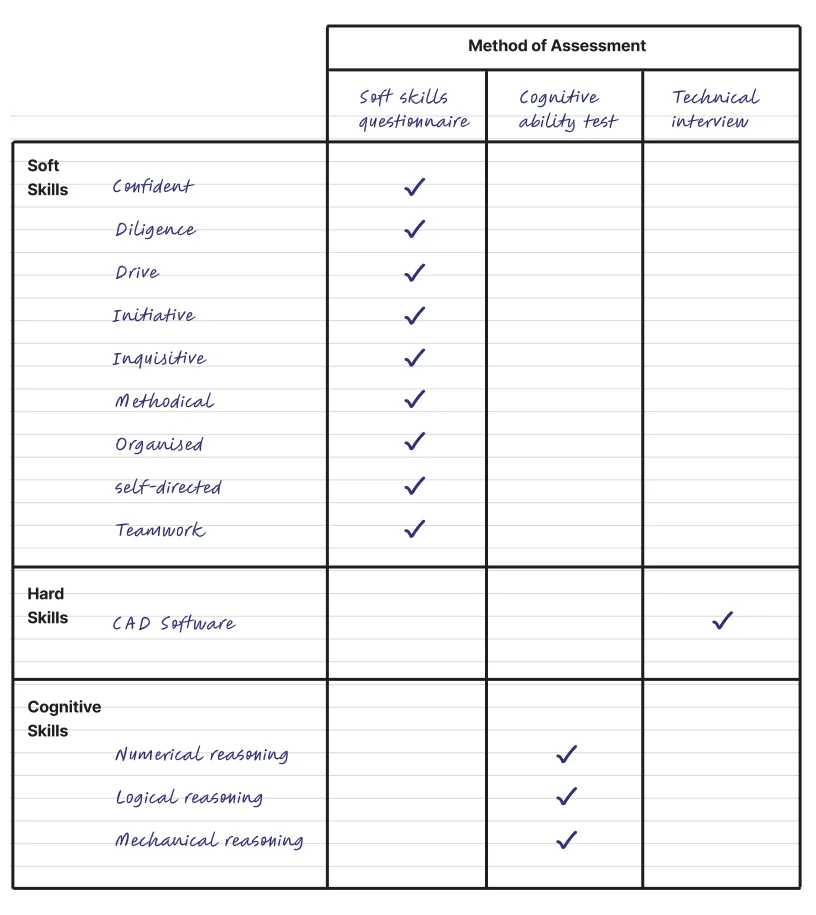
In practice, the most effective way to set this up is:
Volume stops being a problem. The more people who apply, the bigger the pool you're drawing your best candidates from.
Download to follow along this excercise of implementing your own skills-based hiring.
Claim your toolkit (PDF, 20MB)As you can see from the steps outlined earlier, skills-based hiring doesn't replace interviews, but refines what they're doing.
In an experience-based process, an interview is largely a probe of work history: "walk me through your time at X", "what was your role in Y project". In a skills-based process, the interview is there to assess specific skills that are harder to measure through tests alone - particularly the interpersonal soft skills.
The practical change is moving to structured interviews, where questions are designed around the skills you've identified and every candidate is asked the same things and scored consistently. If every candidate gets the same questions scored against the same criteria, you're comparing like-for-like. If the conversation goes wherever it goes, you're comparing apples and oranges.
Two approaches tend to work well.
Situational questions ("how would you approach this scenario?") assess capability without relying on past experience, which removes the advantage that well-coached candidates have over equally able ones with less polish, or competency based questions.
Let's take our CSM role, one of the key interpersonal soft skills identified was "Empathy/customer-focus". As it's interpersonal it's something best assessed face-to-face in an interview.
Situational: "A long-standing customer gets in touch, clearly frustrated. They feel like they're not getting the attention they deserve and they're hinting they might look elsewhere. You know they've actually had a lot of your team's time recently, and some of their frustration isn't entirely fair. How do you handle that conversation?"
Competency: "Tell me about a time when a customer or client was deeply frustrated. How did you handle their emotional reaction alongside their actual problem?"
Now remember, these are structured questions, so you would have already determined what a weak, average and strong answer looks like before you've even asked the question (maybe scoring criteria from 1-5). You just need to score them based on your pre-determined criteria, so you're being consistent and fair across all candidates.
What's great about a skills-based hiring approach is that it allows you to work out whether your process is actually working, and make refinements to improve your quality of hire.
You have the data to answer the question of "did this person work out? and how come?".
Your assessments produced scores. Your interviews produced structured ratings. Your hires are now in roles where their performance can be observed. Running correlations between assessment scores and performance ratings, tracking whether each cohort is better than the last... these things can tell you what's working and what isn't.
For smaller hiring volumes this can take time to build up, and getting statistically meaningful data isn't always straightforward. But even directional feedback is useful. If candidates who scored highly on a particular assessment consistently turn out to be strong performers, use it earlier and weight it more heavily. If something you thought mattered turns out not to differentiate at all, drop it.
The five steps aren't complicated: identify the skills, rewrite the job description, screen with assessments, restructure interviews, and keep improving. What takes work is doing the thinking upfront and getting the right people bought in.
The toolkit below can be used to make the planning stages easier. It walks you through the brainstorms, gives you frameworks for each skill type, and includes templates and examples you can adapt for your own roles. Download it, work through it with your hiring team, and if you get stuck at any point our team at Test Partnership are happy to help.
And once you have identified the skills you want to assess, we have assessments designed to measure all of that for you:
So get in touch with us if you want to find out more, schedule a demo, or just chat to us about whether skills-based hiring might work for you.
Download to follow along this excercise of implementing your own skills-based hiring.
Claim your toolkit (PDF, 20MB)
Chief psychologist at Test Partnership. MSc in Organisational Psychology with over 10 years' experience in psychometric testing.

