Why ability assessments are perfect for early careers hiring
 2 minutes
Find out why there no greater use-case in using ability assessments than for early careers recruitment.


Hiring for early careers works best when you stop focusing on experience and start measuring potential. The most effective approach is simple: assess cognitive ability at scale, shortlist only the top performers, and keep interviews lean and structured. It's faster, fairer, and uses the two most predictive selection methods.
Below is the evidence-based early careers hiring model used by high-performing talent teams, which you can adopt in your own process.
CVs aren’t very useful for early careers hiring, because most of what they contain (school name, brief internships, extracurriculars) tells you little about how someone will perform in the role.
It's no secret that higher socioeconomic status (SES) individuals have an advantage when it comes to educational achievement, university choice, extracurricular activities, and relevant work experience. By using those metrics you are weakening diversity and advantaging high SES candidates who can afford to pad out their CV with superficially impressive experiences.
Candidates can now use AI tools to produce polished CVs cover letters, and written answers instantly, making these methods even more unreliable indicators of ability or interest than they were before.
Removing CVs at the first stage gives everyone the same starting point and avoids rewarding polished applications over real capability. It also helps you avoid false positives from candidates who look great on paper but lack the core skills needed for the role.
Focusing on potential rather than experience creates a fairer process and a more accurate shortlist.
General mental ability is the strongest predictor of workplace performance for early careers, supported by decades of research including Schmidt and Hunter (1998) and updated meta-analyses such as Schmidt, Oh, and Shaffer (2016). These findings show that cognitive ability predicts both job performance and training success, which are central to early careers roles.
Early careers roles rely on fast learning, adaptability, and problem solving, not prior work history. Ability tests capture these qualities directly and consistently outperform other selection methods for younger applicants. It makes sense to follow the data and use ability tests as the foundation for early careers hiring decisions.
| Selection method | Predictive accuracy (r) |
|---|---|
| 🟢 General mental ability (GMA) | 0.65 |
| 🟢 Structured interviews | 0.58 |
| 🟡 Integrity tests | 0.46 |
| 🟡 Job knowledge tests | 0.48 |
| 🟡 Assessment centres | 0.36 |
| 🟠 Biographical data | 0.35 |
| 🟠 Work sample tests | 0.33 |
| 🟠 Personality (conscientiousness) | 0.22 |
| 🔴 Years of education | 0.10 |
| 🔴 Extracurricular activities | ~0.00–0.10 |
 Pro Tip
For a more complete picture of each candidate, combine cognitive and personality assessments to help understand each candidate's drives, motivations and team-fit.
The most effective early careers programmes use ability tests to assess everyone at the start, then interview only the highest scorers. This combines the two most predictive selection methods and gives you a high-quality shortlist without wasting interviewer hours on unsuitable candidates.
The reason this works so well is that the value you get from any selection method is directly proportional to how selective you can be. If you interview 20 applicants and pick the top 5, they'll be decent. But if you assess 1,000 applicants with an ability test and pick the top 5, you're looking at the top 0.5% of the pool. A completely different calibre of candidate. The effect is linear: the larger the applicant pool you assess with a predictive tool, the higher the quality of your final shortlist.
This only holds if the tool you're using actually predicts performance! CV screening 1,000 early-career applicants (an impossible job, but stay with me...) and discarding 95% of them won't give you a meaningfully stronger shortlist than some of the ones you discarded. But as ability tests are the strongest predictor of job performance we have, being highly selective works exactly as it should.
And crucially, assessing 1,000 people with an ability test is a one-click process. You're not adding extra workload to your desk. And because they're so predictive, you can keep the interview pool small and still feel confident in your shortlist, you don't need to hedge by interviewing more people just in case.
2 minutesFind out why there no greater use-case in using ability assessments than for early careers recruitment.
It's tempting to have multiple interview rounds as it feels more thorough, but research shows it doesn't improve accuracy for early careers applicants. Once you have a structured interview in place, extra rounds add very little because they tend to uncover limited new information (Levashina et al., 2014). Adding more interviews increases time and cost far more than it improves decision quality (Cascio & Aguinis, 2019).
Too much focus on interviews often reward confidence and communication style more than genuine competence, especially for applicants with limited experience.
Keeping interviews lean makes the process faster and fairer. One well-designed structured interview is usually enough to confirm the shortlist created by ability assessments.”
We've established the best strategy uses assessments early then a structured interview for the shortlist, but which assessments do you choose?
Traditional assessments (numerical, verbal, logical reasoning) each measure only one ability at a time. General mental ability is the combination of these abilities. To measure it properly using traditional tests, you would need to give candidates several separate assessments, often 20–30 minutes each. This results in long, fatiguing test sessions that cause drop-off and poorer performance in later tests.
The rise of generative AI also means that many traditional formats can be assisted, weakening both fairness and reliability.
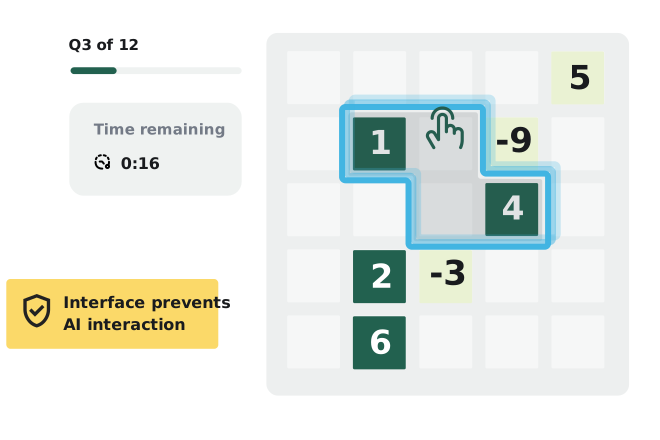
MindmetriQ™ game-based assessments were designed to solve these issues. They measure the core components of general mental ability (numerical, verbal, logical reasoning) in fast 4–6 minute tests. They also capture important sub-facets such as working memory, spatial reasoning, and adaptability. This further helps capture an accurate measure of general mental ability (g).
In just 12–15 minutes, you can measure general mental ability accurately without long test sessions, fatigue, or AI-assisted cheating.
Test Partnership’s MindmetriQ assessments deliver a fast, mobile-friendly experience that suits early careers candidates. The interactive format keeps applicants engaged, and the AI-resistant design protects the integrity of your hiring decisions.
Candidates consistently report that the process is more enjoyable and less intimidating than traditional testing, leading to higher completion rates and a stronger candidate experience overall.
A two-stage process is the most predictive and efficient model for early careers hiring.
This model is simple, equitable, and driven by evidence rather than background or polish.
The strongest early careers decisions come from combining the two most predictive selection methods: cognitive ability tests and structured interviews.
Together, they give you the clearest view of who can learn quickly and perform well, while removing the noise, bias, and wasted effort that comes from CV sifts and multiple interview rounds.
It's a faster, fairer, and more accurate way to identify high-potential talent, and helps build a stronger early careers pipeline.
If you’d like to see how we support early careers teams or discuss your hiring needs with one of our business psychologists, visit our early careers page or book a call with our team.

Digital Marketing Manager at Test Partnership. Over seven years' experience as a writer, content strategist, SEO and digital marketer.
