The top four reasons for using ability tests
 1 minute
Ben gives an outline of the four main benefits of using ability testing


Ability tests, also known as aptitude tests, cognitive ability tests, or intellect assessments, are the world's most commonly used psychometric assessments. Thousands of graduates and apprentices are tested every year as part of recruitment programmes. Ability tests have become a mainstay of early-stage selection processes and their usage is only increasing.
The common job interview is viewed as the main selection tool by many (and will rightfully remain in all hiring processes), but thinking is shifting and the evidence is clear that ability tests are king.
A 2016 paper by Schmidt, Oh, and Schaffer analysed 100 years of selection method research and suggests that not only should ability tests be considered the primary selection tool, but all other selection tools should be viewed as mere supplements (bow down to the king!).
In this article, we'll cover why you might want to start using ability tests, what to look for when choosing a supplier, as well as some other interesting ability testing topics and questions.
Ability tests are standardised assessments which measure specific cognitive aptitudes, such as verbal reasoning, numerical reasoning, and inductive reasoning.
Each of these aptitudes measures an individual's ability to work with that specific information source. For example:
A general ability test is a test which combines questions that assess different aptitudes (numerical, verbal, inductive) in order to determine someone's general reasoning ability.
General mental ability (GMA) is a broad, overarching measure of a person's cognitive horsepower, determining how well they can learn, solve problems, and make effective decisions in general. GMA is not aptitude specific like aptitude tests, and those scoring highly on GMA overall will be able to work with any information source, regardless of whether it is quantitative, qualitative, or abstract.
General mental ability is what Schmidt, Oh, and Shaffer said was the most predictive selection method. From a scale of 0 to 10, GMA had a predictive validity of 0.65 (if you don't know much about validity statistics, that's huge!), for comparison, structured interviews scored 0.58, assessment centres 0.36, and years of experience scored 0.16 (welp!).
When using ability tests in your hiring process, you want to include multiple different types as a combination of ability tests (numerical, verbal, inductive) will form an overall measure of general mental ability (GMA)."
Although the reasons to add ability tests into your selection processes are plenty, there are four key reasons to do so which I'll cover now (or you can watch the short overview video below).
1 minuteBen gives an outline of the four main benefits of using ability testing
The main reason to add ability testing into your selection processes is that they are the strongest predictors of real-world job performance known (Schmidt, Oh, and Schaffer, 2016). What I find particularly beneficial is that as the cognitive complexity of the job increases, so too does the predictive power of ability tests.
For example, in highly complex managerial work, ability tests account for more than half the variance in performance. That means cognitive ability has more influence on how well a manager performs than every other factor combined. No other employee selection tool is as predictive of performance as a battery of ability tests, they really are indispensable tools when it comes to maximising the quality of hire and identifying high potential candidates.
The reason behind the predictive power of ability tests is simple to understand. Research shows that ability test scores are especially predictive of the following work-related behaviours and skills (Gottfredson, 1997):
You'll be aware of how important it is to have people who can solve problems quickly on your team, particularly when things go sideways and quick thinking is the difference between a minor setback and a major one. The same goes for learning and retaining job-related information, which underpins performance in virtually every role you can think of.
Not only does higher cognitive ability tend to maximise performance, but lower cognitive ability vastly reduces one's ability to perform at work. Those scoring low on cognitive ability tests tend to struggle in all fields of work, but especially complex work, failing to meet the learning demands of the role and struggling to carry out their tasks without errors.
Overall, cognitive ability allows people to learn, solve problems, make effective decisions, react quickly, and deal with uncertainty, making it a hugely valuable asset when maximising the performance of employees. To summarise the academic consensus around ability testing and job performance, Hunter (2002) said "The purely empirical research evidence in industrial and organisational psychology showing a strong link between GMA and job performance is so massive that there is no basis for questioning the validity of GMA as a predictor of job performance".
For all you early-careers people, you'll know the trainability of employees is essential (more so than any pre-existing experience). In structured graduate, apprentice, and internship schemes, employers spend huge sums of money and invest significant resources into their graduates, largely in the form of training schemes, qualifications, and professional certifications. This investment usually generates an extremely high return, but it does rely on hiring staff who can effectively absorb and apply what they have learned in their future role.
Research shows cognitive ability is an even stronger predictor of training performance than job performance (Schmidt & Hunter, 1998).
This is because cognitive ability increases a person's bandwidth for learning, allowing them to acquire and retain more information. Intuitively, this makes sense, as we all realise that cognitive ability is the primary determinant of learning, with smarter people learning the most from structured training and educational programmes. However, what many do not realise is that this effect is linear, so staff with lower cognitive ability will desperately struggle to benefit from complex training programmes.
This has three important implications:
These three (as well as many other factors) highlight how cognitive ability must be strongly emphasised during the selection process.
Moreover, lifelong learning and ongoing professional development is increasingly emphasised at all levels, not just in emerging talent. This makes hiring low-cognitive ability staff even more dangerous, as you will be onboarding staff who will struggle to keep up at every stage in their careers, falling behind their peers year upon year. Not only will this exasperate any capability issues, but will inevitably reduce employee engagement.
A major non-psychometric advantage of modern ability tests, is that they are online and highly scalable, allowing you to evaluate tens of thousands of applicants in mere hours. No other selection tool offers this level of automation, especially when used as part of a high-volume recruiting sift (imagine CV sifting that many applicants - help!).
It's an extremely simple process to screen candidates with ability tests. Candidates take the assessments and their results appear in your assessment platform or ATS. You apply an appropriate cut-off, progressing sufficiently high scoring candidates and screening out those who failed to meet the standard. The amount you choose to progress depends entirely up to how many more assessment rounds or your level of resources.
You could never face-to-face interview all your applicants. It takes up several hours to just plan, arrange, conduct, evaluate, and provide feedback for each candidate.
 Pro Tip
Ability tests are the perfect screening partner to interviews. Studies show GMA plus a structured interview have a combined validity of 0.76. Using ability tests on your applicants and progressing the top performers into interviews is maybe the most efficient and predictive selection process available.
Ability tests can also be completed on a wide range of devices, including desktop, laptop, tablet, and mobile devices, making them far more accessible than other tools. Many ability tests, especially those designed in line with gamification principles, could be designed specifically for mobile, making them particularly accessible to those who do not have immediate access to a desktop or laptop device. Similarly, psychometric testing platforms are usually designed to be compatible with screen reader software and other accessibility packages, ensuring that almost everyone can participate fairly.
The second non-psychometric benefit of ability tests is their objectivity, as they do not require a human marker or assessor who may introduce unconscious bias into the selection process. This removes the possibility of interpersonal bias (whether intentional or unintentional) from this stage in the recruitment process, ensuring that high performers aren't screened out due to irrelevant demographic factors.
For example, during a traditional CV sift, many hiring managers often unintentionally show preference to candidates from specific backgrounds or universities (not you, of course, lovely reader), usually benefiting those from majority groups or with higher socio-economic backgrounds.
Ability tests do not allow the biases of assessors to affect selection decisions, as the only factor which will determine success or failure is performance on the test itself. As a result, ability tests are most commonly used immediately after application, ensuring that human bias cannot enter the recruitment process during the shortlisting stage.
To further improve fairness, during the initial research and development of the ability tests, any psychometric test publisher worth their salt will conduct adverse impact analysis and differential item functioning (DIF) analysis. This ensures that the assessments themselves are not inherently biased against candidates from specific demographic groups, i.e. based on ethnicity, age, or gender etc. Questions which are found to be disproportionately difficult for a particular group will be removed before taking the product to market, ensuring fairness and objectivity from the outset.
Few other employee selection tools undergo such rigorous quality control, there's no such analysis for interview questions or CV screening metrics, in fact most selection tools undergo no quality control at all.
Not all ability tests are created equally, and so it's important to know what features to look for. This is super important as the ability testing stage is likely to screen out more candidates than any other. You may test 10-100 times more candidates than you interview. Getting the ability testing stage right is vital to ensure a quality shortlist, making all subsequent stages in your hiring process considerably easier.
Aside from the obvious indicators of quality, such as validity and reliability, there are certain scientific advances in psychometric testing to look out for as these maximise the practical utility of ability tests.
As ability tests are taken online, there is a real threat of cheating. We always recommend using ability tests that utilise item banks (large bank of questions), never fixed-form tests.
Item banking works by having test publishers account for the difficulty of each question alongside the number of correct responses from the candidate, which frees the assessment from needing a fixed set of questions. Each candidate receives a unique set of questions, so even if someone leaks and distributes what they saw in their test attempt, it gives cheating candidates almost no advantage.
Item banking works hand-in-hand with the next feature, adaptive testing...
We recommend choosing assessments which employ Computer Adaptive Testing (CAT) methodologies. CATs use their large item banks to tailor the testing experience to each specific candidate, getting harder following correct answers and easier following incorrect answers. This allows the test to home-in on the candidate's true level of ability, using both the difficulty of the questions and the number of correct responses to calculate a candidate's score. This has a number of advantages over giving candidates a random selection of questions:
Gamified assessments have been around for a while, but are recently have a strong uptake due to the threat of AI-assisted cheating. Well-designed gamified ability tests, not the corny behavioural games like don't pop the balloon or match the birds, have proven themselves to be just as effective as traditional ability tests. The really well-designed ones, like MindmetriQ, are even more effective as they allow for the creation of more cognitively complex tasks (assessing various sub-facets of cognitive ability like working memory or quick decision making, not just the core ability of each test like 'numerical reasoning').
Gamified assessments can also be much shorter and more engaging - providing a very positive candidate experience compared to traditional methods.
However, traditional ability tests still have their place, and more senior candidates will likely prefer a traditional ability test to something which is gamified. With this in mind, we advise you work with a test provider that can offer both types. In doing so, you are able to utilise gamified ability tests for emerging talent recruitment, which will almost certainly improve the candidate experience. And traditional ability tests for experienced professionals, managers, and executives, stressing upon them the seriousness of the endeavour and showing the appropriate level of respect.
Candidates will attempt to cheat your ability tests using ChatGPT (or whatever their preferred AI tool is). This is a fact, and I'm sure you're aware of the threat - it's what everyone is talking about in TA right now.
This makes it important to have measures in place to prevent cheating. If you're using a test provider with weak anti-cheat measures, then the validity of the assessment results you're receiving are lower than they could be. There are lots of anti-cheat measures such as forcing full-screen, monitoring mouse behaviour, proctoring... However, a lot of these harm the candidate experience.
If you're working in early-careers, I think the best approach is to use gamified assessments. Their game-based design not only make them more candidate-friendly, but offer built-in AI-resistance. Let's take a gamified MindmetriQ assessment for example: Net the numbers is a numerical reasoning task which comprises of 10 questions. Each question is 10 seconds long and requires constant quantitative processing and spatial reasoning to work out the correct answer. What the candidate is tasked with is to find the position where the fixed-shape net can be placed on the board whereby the sum of the numbers within the shape, is the highest possible sum.
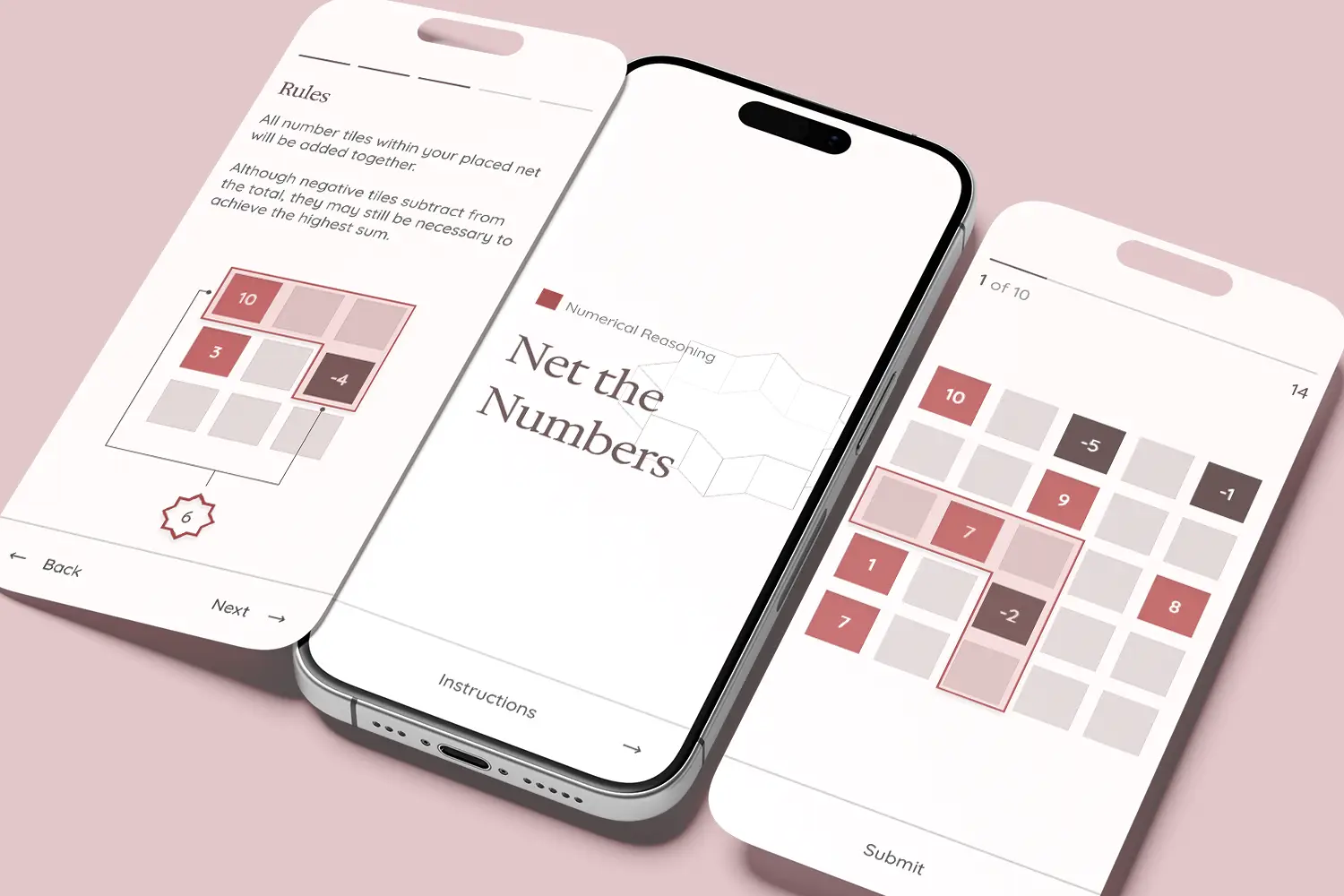
AI won't be able to assist in this assessment. Not only would it be extremely difficult for the question to be submitted and receive a response within 10 seconds, the candidate would also need to then place the net in the right position and hope the AI got it right. And AI is notoriously bad at logical and image-based tasks. Let me pull back the wizard of Oz's curtain on why: AI is a broad term, and there are AI models that have existed for decades and can reason with logical problems (chess computers, for example). But the ChatGPTs and Claudes of the world are LLMs (large language models). How they fundamentally work is they convert your questions into tokens, then use their training data and statistics to predict what the next word should be in their response. These LLMs don't actually "know" what the final answer is going to be that they produce, they're just building their response by predicting the next likely "token" or word.
Logical reasoning puzzles require a chain of reasoning that isn't as predictable or solvable by grammar or existing data. You can train AI systems to solve logical puzzles more effectively, but they largely need the context first (like training them on a specific game like chess). Present a task like Net the Numbers and, without sufficient training on the game, it simply won't know what to do.
Yes, they can. In the past 100 years of organisational psychology research, no role has been identified where performance isn't meaningfully associated with cognitive ability. That said, how you use them, and what you're looking for, should vary depending on who you're hiring. Here's how we'd approach it by level.
Although ability tests tend to be used less frequently in blue collar roles, research suggests that they are still useful predictors of future performance in even the simplest of roles (Schmidt & Hunter, 1998). Don't set pass marks too high, you only need to ensure a reasonable minimum standard. This ensures that all candidates meet a minimum requirement for numeracy and verbal skills, along with a requisite level of trainability. The assessment experience should be kept relatively quick as the assessments will not appear relevant to the role, and so shouldn't be over-emphasised.
Ability tests are perhaps the most useful in emerging talent recruitment, due to the cognitive complexity of the roles, the trainability requirements, and the high volumes. We recommend using the ability tests as early as possible, ideally immediately upon applying. Organisations are advised to be as selective as they can possibly be, and feel comfortable screening out 50-90% of their applicants using ability tests. The ability tests must be kept relatively short, as candidates are likely busy with their studies and on other recruitment processes, with 30-45 minutes being reasonable.
We outline our recommended early careers hiring strategy which allows you to assess full cognitive and behavioural aspects in as little as 30 mins.
Many employers feel less comfortable using ability tests with experienced employees, which is unwarranted. Ability tests are still the number one predictor of success, it's just important to ensure that the messaging is appropriate. You're not underplaying their experience, but using ability testing to help understand their brain power. You can combine them with job knowledge tests to make the overall assessment feel more relevant.
While I've been largely complimentary to the use of ability tests in employee selection, I must mention the things they cannot do (that you may be hoping they can). They're designed to measure a specific set of psychological constructs, and don't capture every aspect of performance.
1 minuteThere are limitations to ability tests. It's important to understand what information they can't provide you.
It's important to understand they will not tell you anything about the following:
Ability tests are excellent predictors of task performance, the technical demands of the role. However, ability tests do not address contextual performance, the social and psychological aspects of the role which contribute to the organisation indirectly. What does that even mean? Well, contextual performance are the behaviours that go beyond their assigned duties, such as a tendency to put themselves forward for difficult jobs, follow the company's rules and guidelines, or helping their coworkers. These are more closely aligned to personality traits than cognitive abilities, and so recruiting for cognitive ability alone will not maximise this form of performance.
Cognitive ability is not a predictor of organisational culture-fit, person-environment fit, or even person-team fit, and shouldn't be used to measure them. I'm sure you've met people who are highly technically proficient, but struggle to fit into their organisation or team, resulting in lower employee engagement. Cognitive ability doesn't tell us anything about values, principles, or goals.
Behavioural assessments and interviews must be used to ensure organisational-culture fit, as ability tests are simply not designed to measure these traits.
Wouldn't it be lovely if your smartest employees also stayed the longest - it would makes things much simpler. It's actually true that very low performers on cognitive ability tests are likely to leave their role early (by choice or otherwise), but unfortunately cognitive ability is not associated with tenure length.
Naturally, the smartest and most technically proficient staff are in high demand in the employment market, and are just as likely to seek alternative employment as anyone else. That isn't to say they are more likely to leave than lower scoring employees, but that ability tests will not be an effective tool for improving employee retention. Instead, (there's a trend emerging...) behavioural assessments targeted to organisational-fit or role-fit could help with this, and will have a far greater positive impact on retention rates.
As the previous sections have mentioned, there's a wide range of soft skills and personality traits that are essential to performance at work, but are entirely unmeasurable using ability tests. For example, interpersonal skills and emotional intelligence (EI) are key to working with colleagues, customers, managers and stakeholders, but are not measured directly by ability tests. Similarly, certain intrapersonal traits, such as resilience, conscientiousness, industriousness, and integrity are vital for both task and contextual performance, but fall completely outside the remit of ability tests.
Can you guess what can be used instead?
Yep, a personality questionnaire can measure these traits, creating a well-rounded profile of each candidate. We have a similar breakdown to this one about why personality tests for valuable for hiring for more information.
Cognitive ability, as measured by ability tests, is the most important individual psychological variable known to man. It quite literally separates humanity from the rest of the animal kingdom, and has allowed us to thrive in ways never before seen in nature. Cognitive ability is the primary factor that distinguishes Nobel Prize Laureates and tech billionaires from chronic underachievers, and is by far the largest individual predictor of success in school, work, and in life more generally.
That being said, cognitive ability is but one piece of the puzzle, and a wide variety of behavioural characteristics exist which will either compliment high cognitive ability or compensate for lower cognitive ability.
In summary, I will outline these main recommendations for using ability tests in recruitment and selection:
At Test Partnership, we have ability tests, behavioural assessments and gamified ability tests too. All produced to the highest psychometric science, allowing you to screen with confidence.
Ability tests are the broadest predictor, but rarely the only assessment worth running. See how ability tests compare with other candidate assessments and which combinations tend to work best.

Chief psychologist at Test Partnership. MSc in Organisational Psychology with over 10 years' experience in psychometric testing.

