
AI-resilience in assessments
Why a 5% cheating rate can affect half your shortlist, the 12 selection methods ranked by AI-vulnerability, and the nine-principle ACT framework. Fully referenced, honestly caveated.
Free. No email required.


Test Partnership is used by 6,000+ organisations, including


WHY THIS PAPER EXISTS
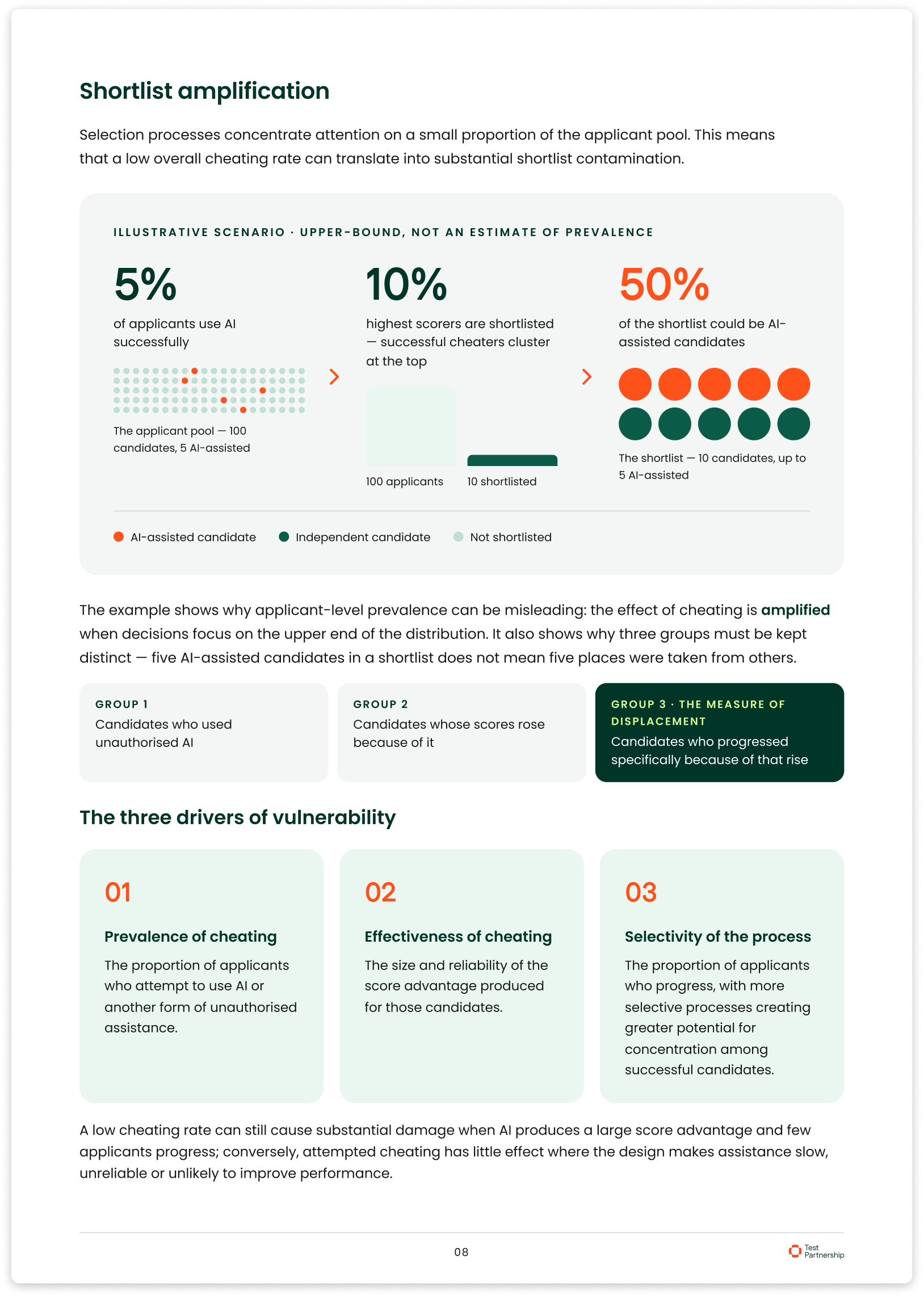
"Only a small percentage of candidates cheat" is the most common reassurance in assessment — and the most misleading.
You don't hire from the applicant pool. You hire from the top of it, which is exactly where successful AI-assisted candidates cluster. This paper works through what that means: every claim referenced, every limit stated, no promises of "AI-proof".
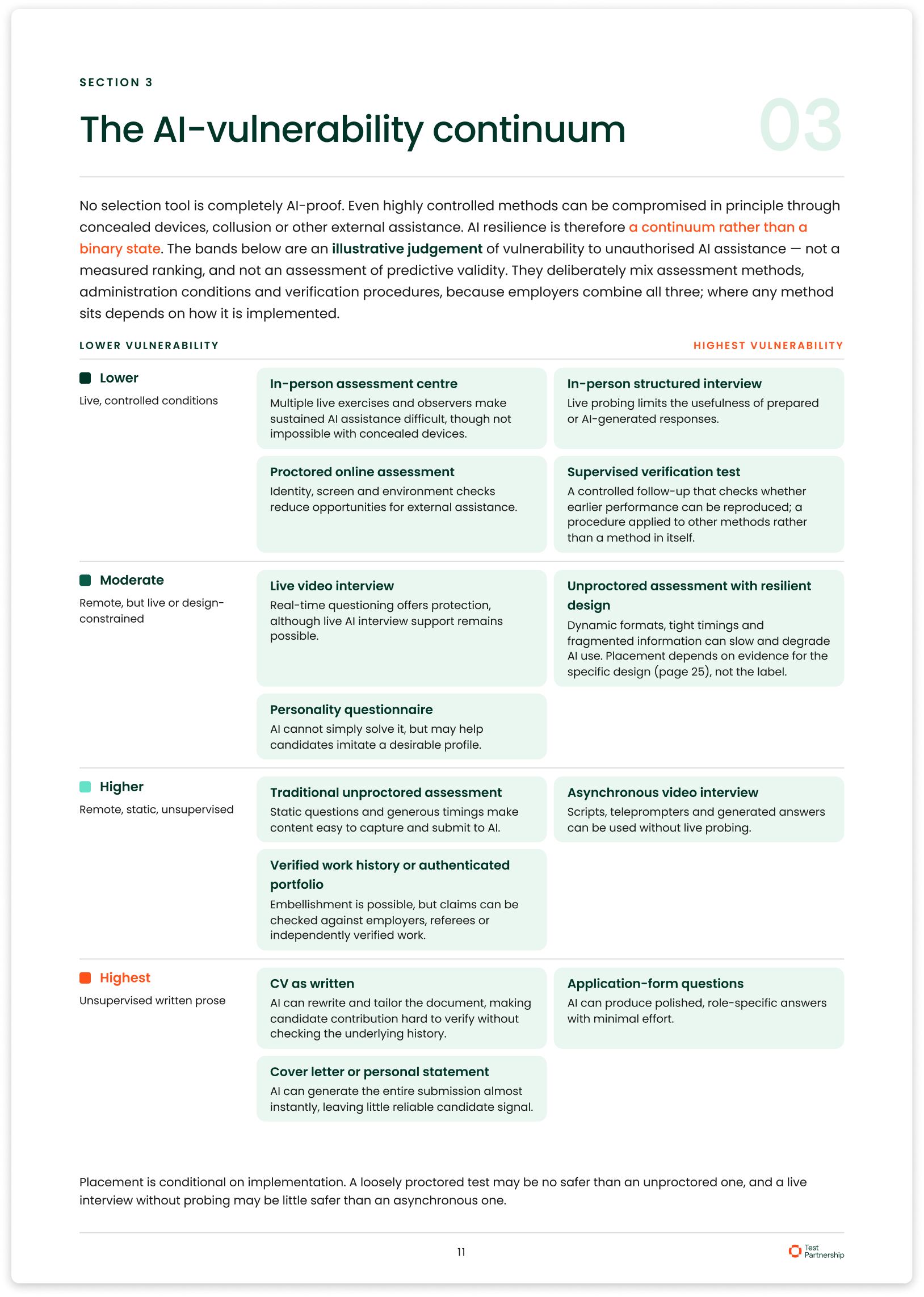
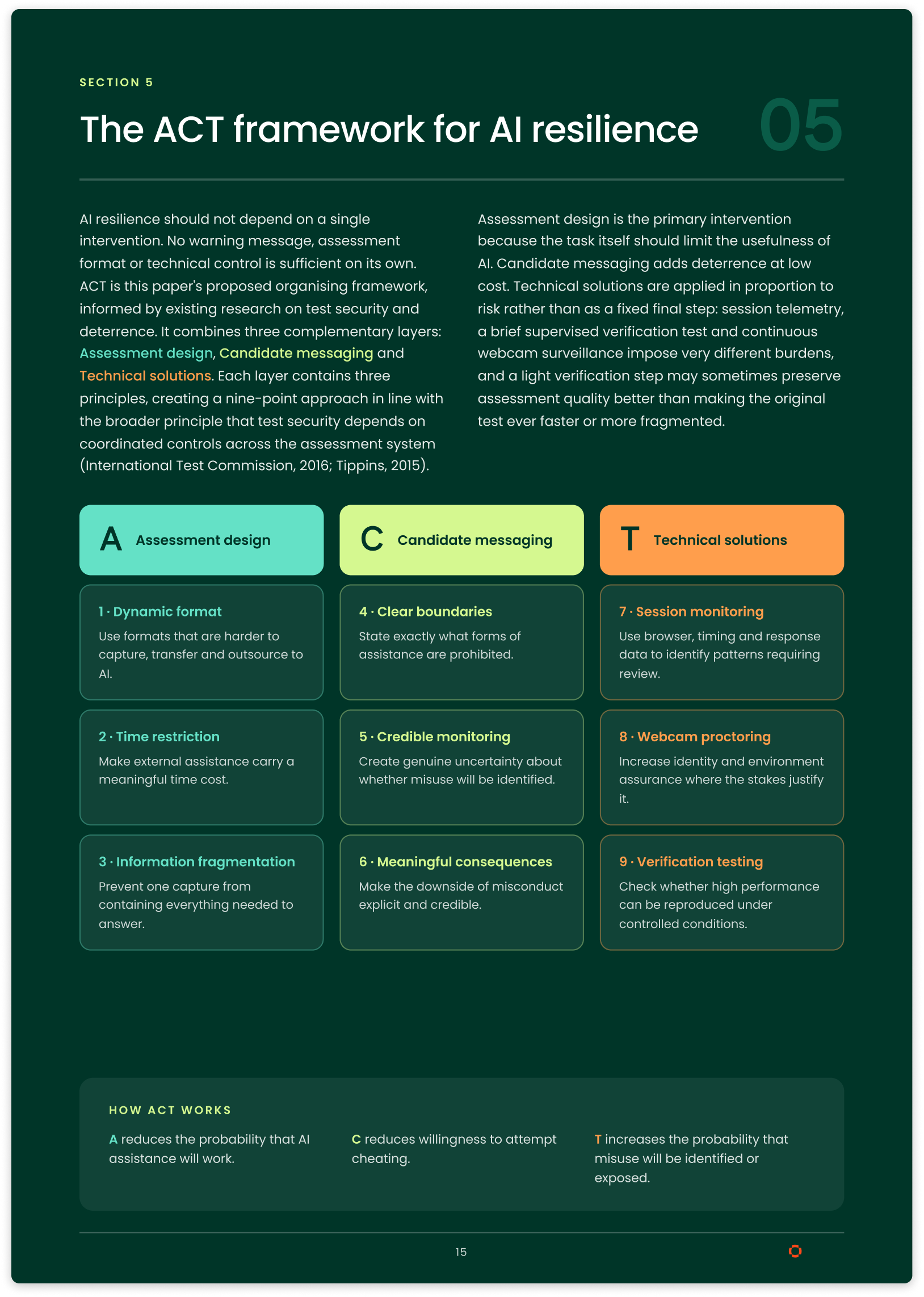
Four ideas that change how you look at your hiring process
Select an idea to see the page it comes from. Every one is worked through fully in the paper itself, with the maths, the evidence and the caveats.
WHAT'S INSIDE
Eight sections,
one argument
From defining what AI resilience actually means, to the seven questions that separate providers who've redesigned their assessments from providers who've redesigned their marketing.
- 01Defining AI resilience
- 02Why AI-assisted cheating matters
- 03The AI-vulnerability continuum
- 04Why parts of the market downplay the problem
- 05The ACT framework
- 06Cheating personas
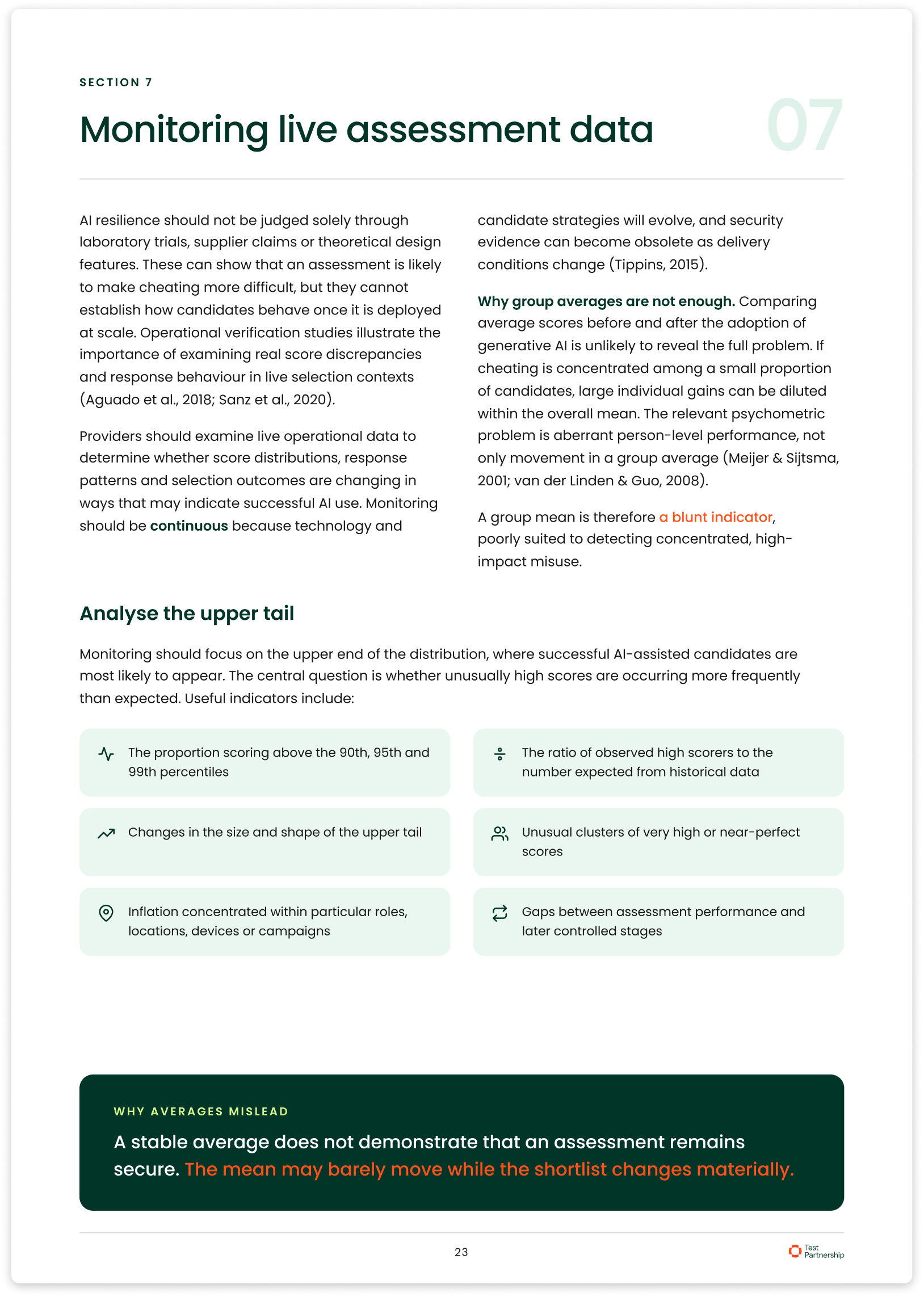
- 07Monitoring live assessment data
- 08Recommendations & the provider checklist
WHAT YOU CAN DO WITH IT
Read it once.
Use it three ways.
The paper is written to be used, not just read: in procurement, in leadership conversations, and in process design.
Take it into procurement
Seven questions that separate providers who've redesigned their assessments from providers who've redesigned their marketing.
Brief your leadership
The shortlist amplification maths, in a referenced form you can put in front of whoever owns hiring risk.
Redesign with ACT
Nine principles in the order they should be applied: assessment design first, surveillance last.
FROM FRAMEWORK TO PRACTICE
We wrote the framework.
We build on it too.
The ACT principles in the whitepaper aren't theory to us. They're the design brief behind our assessments.
Book a call with our psychologists Signal Series
Assessment design as the security layer: one question at a time, short per-question timers, adaptive selection from a growing bank. Explore Signals
 MindmetriQ™
Game-based cognitive assessment, dynamic by design: interactive tasks that resist AI relay by format. Explore MindmetriQ
Trusted by 6,000+ organisations
These clients describe their experience of Test Partnership and our wider assessment service.
Test Partnership is an easy to use resource for testing graduates and junior-mid level candidates. It has been good for replicating tests quickly and integrates very nicely with our ATS system.
Sarah Taylor Talent Acquisition, CloudRock

The platform is extremely straightforward to use. If you need any assistance the support is great.
Andy Hull Operations Director, JB Leitch

Great product and the communication with the team is great, very clear and quite low response times as well!
Nina Voitenko Early Careers Coordinator, Evelyn Partners

The system was incredibly easy to use and was designed bespoke for our needs... it worked really well, saving us time and making the screening process much easier.
Emma Faulconer Talent Acquisition Manager, Cadent Gas

Whitepaper FAQs
Anyone responsible for hiring decisions or assessment procurement: talent acquisition and HR leaders, early careers and volume hiring teams, and anyone evaluating an assessment provider. It's readable without a psychometrics background, while staying rigorous enough to hand to one.
It's an illustrative upper bound, and the paper labels it as exactly that. The mechanism is real: selection concentrates decisions at the top of the score distribution, which is where successful AI-assisted candidates cluster. The paper works through the model, its drivers and its limits openly. We'd rather show you a defensible bound than a precise-sounding fiction.
Fully referenced: personnel selection research, unproctored testing and verification studies, test-security guidance, and generative AI research, with a complete reference list. It's also honest about limits: direct peer-reviewed research on generative AI in employment assessment is still emerging, and the paper identifies its proposals as design propositions rather than established tests.
Really free: no form, no email, no gate. Our reasoning is simple: the paper argues for honest, evidence-led assessment, so gating it behind a lead form would be off-brand. If the framework convinces you the problem is real, our assessments are built on its principles. That's the whole business model, out in the open.
Please do, especially the provider checklist in Section 8. The paper was written to support exactly those conversations: challenging reassuring claims, comparing vendors, and making the case internally for strengthening assessment rather than abandoning it.